





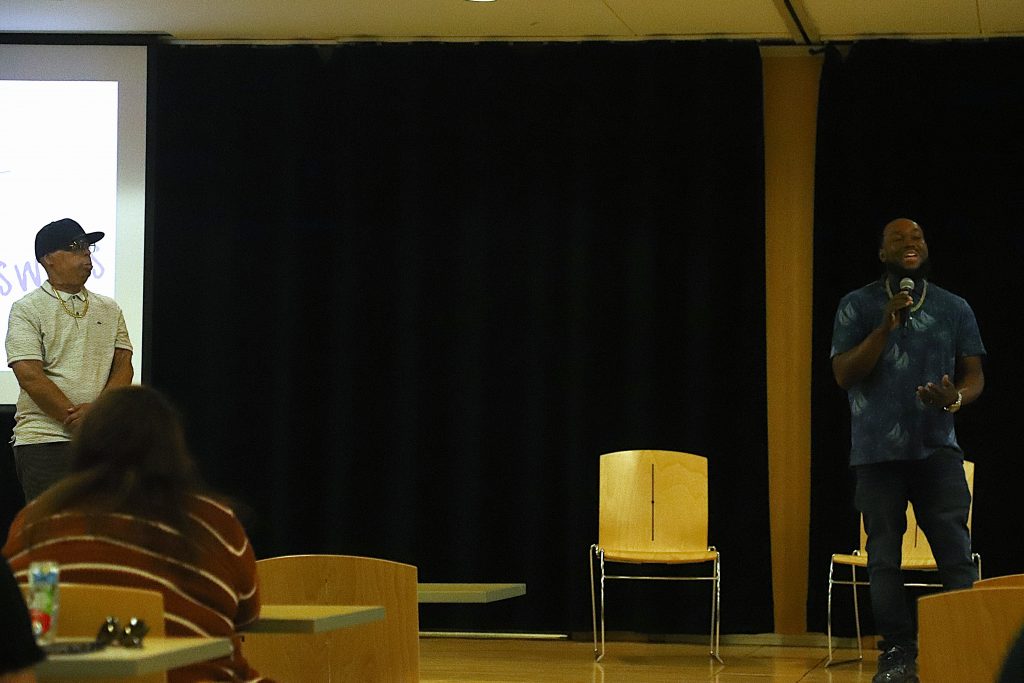
Alvaro Llanos and Shawn Simons, two survivors of a deadly fire at Seton Hall University, shared their story and gave fire safety advice in a talk on Monday.
In collaboration with Binghamton University’s Residential Life and Environmental Health and Safety offices, the talk included a screening of the documentary “After the Fire: A True Story of Heroes & Cowards,” which centered around Llanos and Simons’ recovery and the investigation into the fire. Afterward, the two spoke to the crowd about their experience and general fire safety, before the floor was opened to audience questions.
“What we have done is we’ve turned our tragedy, in a sense, into an educational and inspirational story for young adults, especially who are living on college campuses, just to show them the importance of fire safety and fire prevention from our perspective,” Simons said in an interview with Pipe Dream. “We’re not firefighters, we didn’t go to school to learn this. We were students, and we thought we were invincible, that nothing could happen to us, and unfortunately, the situation did.”
“Now we’re just trying to embrace that tragedy in order to help others,” he continued.
On Jan. 19, 2000, two students, Sean Ryan and Joseph LePore, set fire to a bulletin board in Boland Hall, a freshman dormitory, as a fraternity prank. Because the building did not have a sprinkler system, the fire spread rapidly. Three students passed away — Aaron Karol, Frank Caltabilota and John Giunta — and 56 more were injured.
Llanos and Simons, then 18, were two of the most severely injured students. They awoke at 4:30 a.m. to the fire alarm, which Simons said frequently went off as a result of pranks. Expecting another false alarm, the two tried to leave, only to be met by intense heat and smoke.
The two crawled out of the room and were separated. Simons was able to escape but suffered burns while crawling, as the fire reached about 1,600 degrees Fahrenheit. While attempting to leave through a door, Llanos was struck by a fireball and set on fire. Two residential assistants helped put out the fire, and they were evacuated.
Simons was burned on 16 percent of his body, suffering serious injuries to his hands, head and face. Llanos suffered burns on 56 percent of his body. The two were hospitalized and put in medically induced comas, Simons for two weeks and Llanos for three months.
The documentary showcased testimonials from their family members, as well as healthcare workers, police officers and other survivors of the fire. Ryan and LePore pled guilty to third-degree arson and witness tampering and were sentenced to five years at a youth correctional facility.
After the screening, Llanos and Simons gave safety tips to the audience in the event of a residence hall fire. As many students attending were RAs, they showed a list of banned items in dorms and urged students to report any potential fire hazards.
They also warned of the dangers of smoke inhalation, the most common cause of death in a fire.
“I strongly urge every single person in this room today that whenever you all hear a fire alarm go off, we need you all to take it as serious as possible,” Simons said. “Stop what you’re doing, get up and get out as quickly as you can. Don’t sit there and look at your roommate and say, ‘Do you think we should go outside?’”
Llanos and Simons told students that when entering an unfamiliar space, check to see if there are multiple exits. They said that in the event of a fire, many people try to escape through the exit they came in from, but that might not be the quickest or safest way to leave the building.
Along with fire prevention tips, Llanos and Simons shared how their recovery taught them invaluable life lessons.
Llanos said that his recovery was both physical and psychological, as he struggled with his identity after being scarred. After fearing how he would be perceived by those around him, he realized that “before society could accept me, I had to learn to accept myself.”
“I had to learn how to love myself, and we all need to learn how to love ourselves a bit more,” Llanos said. “Our scars, our flaws and imperfections don’t define who we are. Everything in our heart, everything we become defines who we are.”
Attendees then asked Llanos and Simons questions. One attendee asked if they were able to forgive the two arsonists. Both said they did and that letting go of their resentment allowed them greater happiness.
While Llanos said he realized he needed to forgive early on in his recovery, Simons said it took him 10 years and a conversation with his mother to forgive.
“A lot of times we say, ‘Oh, we hate a person, we can’t stand a person,’ and nine times out of 10, that person is off living their life not thinking about you one second of the day,” Simons said. “You’re the only person that’s hurting by holding on to that, and when I was able to truly grasp that and be able to say, ‘You know what, there’s nothing I can do about changing the past. If they don’t want to come forward, if they don’t want to apologize, that’s on them. That’s not on me at any point.’”
“Once I was able to truly grasp that, honestly, my life became a lot more positive because I wasn’t holding on to that negative energy,” he finished.