





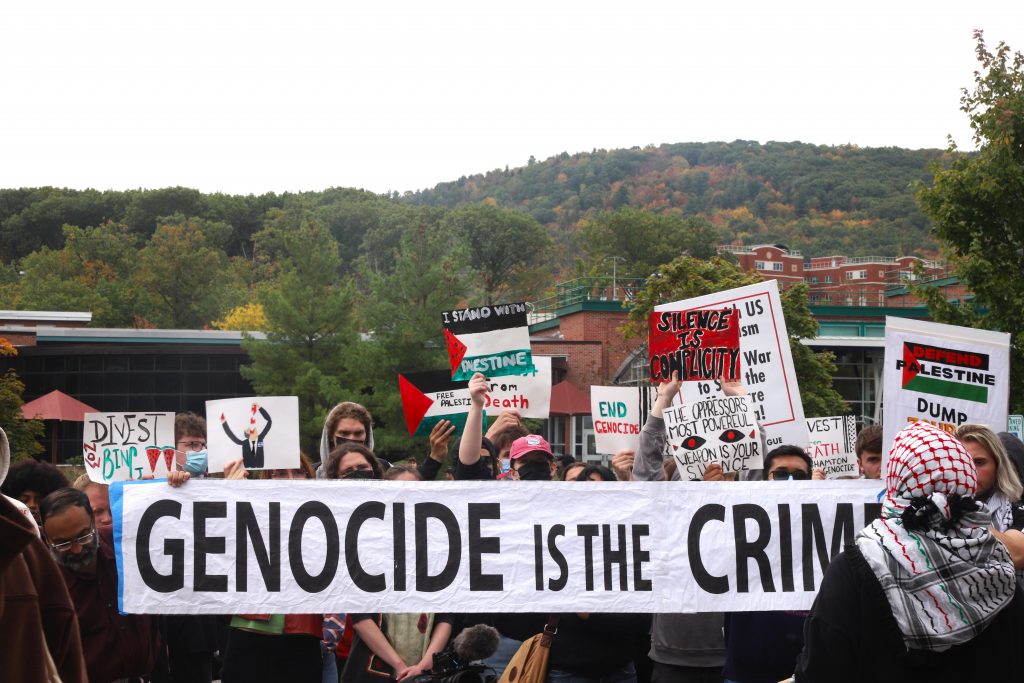
Students for Justice in Palestine held a “March for Gaza” on Tuesday to commemorate the second anniversary of Oct. 7 and show solidarity with Palestinians amid the continued humanitarian crisis in the Gaza Strip.
The march, held in coalition with the Graduate Students for Justice in Palestine, the Student Power Coalition and other local organizations, is part of the SJP’s “Week of Solidarity.” According to an SJP Instagram post, the events of this week aim to “commemorate and commiserate 2 years of genocide” and “reveal the complicity of our institutions.”
“There are dynasties of tragedy written into every Palestinian life,” said a student at the beginning of the march. “Whether born under siege, under occupation or in exile, Palestinians carry 76 years of inherited grief, but also of resilience, and now, two years into Israel’s most brutal, most shameless assault in Gaza, we find ourselves still screaming the same truth, still pleading, still mourning, still counting the dead, if we are even allowed to count them. We should not have to prove our suffering to the world.”
Demonstrators met at the Glenn G. Bartle Library bridge and continued to the Pegasus Statue in front of the Library Tower. Protesters held signs reading “Free Palestine” and “Lockheed Martin Bombs Children” while chanting “from the river to the sea, Palestine will be free.”
The student speaker then continued their speech, highlighting the role of “scholasticide” in the humanitarian crisis. According to the American Historical Association, which condemned the scholasticide in Gaza back in January, the term refers to the systematic destruction of educational institutions.
A member of the Feminist Collective spoke next, emphasizing the role of gendered violence in Gaza. She explained how sexual violence has been used as a tool of war and colonization, dehumanizing women and destroying communities.
“Gendered violence under Israeli apartheid functions as a mechanism of erasure, one that tells Palestinian women that their lives, their knowledge and their futures are expendable,” the speaker said. “It mirrors patterns seen throughout history and other genocides: women’s suffering made invisible, their pain politicized only when it serves the oppressor’s narrative.”
In a September report, the United Nations Independent International Commission of Inquiry on the Occupied Palestinian Territory, including East Jerusalem and Israel, found that Israeli authorities “committed four of the five genocidal acts defined by the 1948 Convention on the Prevention and Punishment of the Crime of Genocide.”
Over 67,000 Palestinians have been killed in the Gaza Strip by Israeli forces over the past two years, according to the Gaza Health Ministry.
The march then moved in front of the Engineering Building. A speaker from Georgia affiliated with the Democratic Socialists of America talked about an effort to build a police training facility on the outskirts of Atlanta. First proposed in 2021, the facility, nicknamed “Cop City,” opened in April after years of protest by the local community.
The speaker argued that building this facility was akin to bringing Israeli military training onto U.S. soil. They also accused Binghamton University of spending money on a “surveillance system that prevents protests from happening before they start,” likely referencing the University’s partnership with Genetec, a Montreal-based surveillance solutions company, to integrate data from its 1,635 surveillance cameras into one system.
In a case study, Dave Martin, assistant director of security infrastructure and support at the University, said unplanned gatherings “can sometimes get out of hand,” but the new video analytics tools can “preemptively alert us” if the crowd is large enough so security can determine if the situation “needs to be addressed.”
A representative from the Muslim Student Association then spoke, reciting a prayer calling for an end to oppression worldwide.
Protesters then marched to the Couper Administration Building. A speaker from the Yiddish Bund condemned collaboration between the Thomas J. Watson School of Engineering and Applied Science and weapons manufacturing companies.
Afterward, a registered nurse talked about their experience last year working in Gaza and described witnessing babies being delivered amid active bombings. They then read a poem they wrote about the humanitarian crisis.
Several counterprotesters waving Israeli flags were also present throughout the march, with several making comments during the speeches.
Next, a student described her time studying abroad last semester and said she saw “more Palestinian flags than I’d ever thought I’d see.” While in Morocco, she met a scarf maker who, upon recognizing her Palestinian pendant, held her hand and said, “We are all Palestinians.”
One counterprotester yelled back, “No guy held your hand, we don’t believe that.”
She continued speaking about her personal experience, telling the crowd she had not “felt that sense of humanity in a very long time.”
Finally, a representative from the Rainbow Pride Union spoke about pinkwashing, a term they said refers to “Israel’s cynical weaponization of a veneer of LGBTQ acceptance to distract from and ultimately justify its brutal oppression of Palestinians.”
“I still truly believe that there’s something beautiful about the fact that all these people come together to support this cause, to talk about this and, honestly, let Couper admin know that we are here and we stand for Palestine,” they said.
Hours after the march ended, the University sent out a Dateline announcement condemning the actions of SJP.
“Even if conducted peacefully, holding a protest on this solemn day was viewed by many as deeply insensitive,” the statement read. “We ask all members of our community to exercise empathy and awareness when expressing their views, considering how and when to do so. Freedom of expression carries with it the responsibility to assess the broader impact of our actions.”
The march was held on the anniversary of the Oct. 7, 2023 Hamas-led attack on Israel, in which around 1,200 people were killed and 250 were abducted. As of yesterday, 48 hostages, 26 of whom are publicly confirmed to be deceased, are still held captive in Gaza.
On Wednesday, President Donald Trump announced on social media that the leaders of Israel and Hamas have agreed to the “first phase” of a peace plan, which involves an exchange of Israeli hostages and Palestinian prisoners. According to Trump, the plan will also include the partial withdrawal of Israeli troops from Gaza to an “agreed upon line.”
In a statement to Pipe Dream, the SJP called the University’s statement “disheartening,” claiming that the University’s actions do not adhere to the code of conduct or uphold principles of freedom of speech and expression. The statement further highlighted cases of alleged harassment against pro-Palestine protesters that have gone unaddressed by the University.
The SJP also argued that despite the controversy surrounding the date of the march, Oct. 7 holds significance for its advocacy as well.
“True, we could’ve held our action on another day, as every day is significant for our cause,” SJP wrote in its statement. “However, October 7th does not have a singular significance that is exclusive to ‘one side.’ We cannot entertain the notion that we are being ‘insensitive’ for holding our action on this day, while in the same breath, Zionists celebrate the Israeli-orchestrated genocide that has only intensified in the two years since.”