





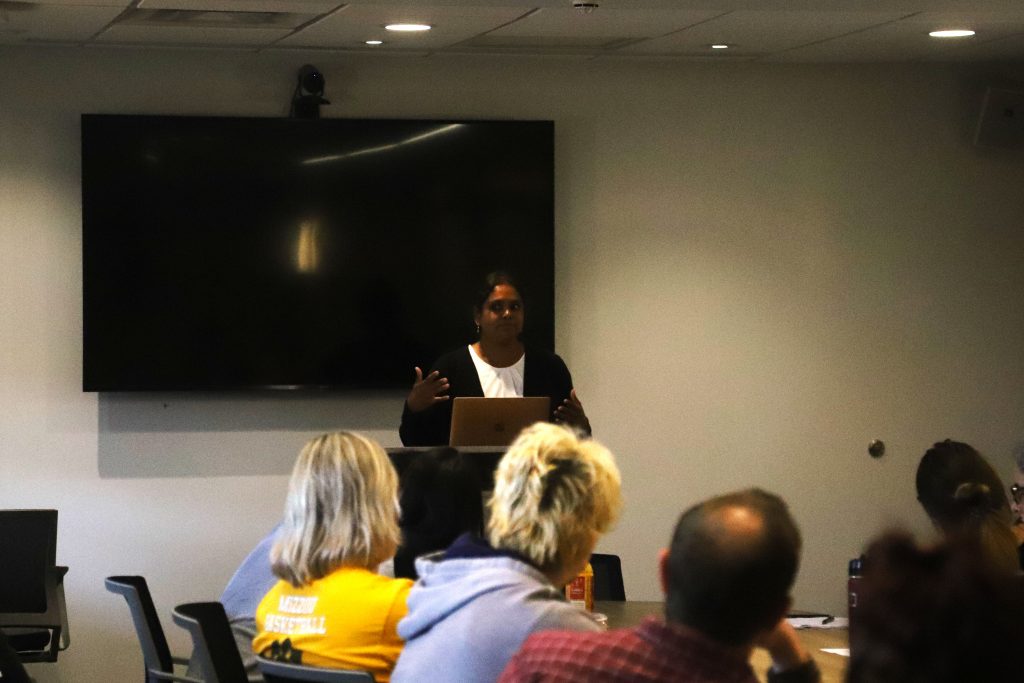
The graduate program in social, political, ethical and legal philosophy hosted a colloquium on Friday for students and faculty to engage in meaningful thought and dialogue about structural injustice.
Japa Pallikkathayil, an associate professor of philosophy at the University of Pittsburgh, gave a presentation entitled “How to Feel About Structural Injustice” and answered questions from the audience.
“The philosophy department regularly hosts lively colloquia at which invited speakers discuss their newest, cutting-edge research on hotly debated contemporary concerns,” wrote Anja Karnein, associate professor and graduate director of philosophy, and Anthony Reeves, associate professor and chair of the philosophy department at Binghamton University, in a joint statement. “Here, faculty and students mingle and openly discuss philosophy at the highest level of the profession. The talk by Japa Pallikkathayil, Associate Professor at the University of Pittsburgh, is a great example of this.”
At the start of the talk, Pallikkathayil provided a handout with a roadmap of her talk’s argumentative structure.
Pallikkathayil first addressed common reactions to structural injustice from a philosophical perspective, including feelings of resentment and righteous indignation. She then described a dilemma posed by David Estlund, a professor of philosophy at Brown University. According to Estlund’s theory, if structural injustice is merely bad, it would not warrant attitudes like resentment, a conclusion that is vulnerable to a “grievance challenge.”
If structural injustice is wrong only because of individual action, Estlund argues that many injustices cannot be classified as such because they are not explained solely by individual wrongdoing.
“This leaves the theorists of structural injustice with a really delicate needle to thread, right?” asked Pallikkathayil. “So they have to be able to explain why social causes matter, but in a way that doesn’t ultimately make it all about individual wrongdoing.”
The presentation then touched on how some replies to this dilemma have been inadequate. Resenting people for their contributions to structural injustice, for example, despite those people not being sole actors or the original cause of the injustice, is a situation she coined as “the mismatch problem.” Pallikkathayil continued, however, by objecting to other philosophers’ arguments, stating that they fail to seriously consider the risks involved in denying victims of structural injustice the space to grieve and react.
Pallikkathayil also argued that an important distinction exists between social structures that may be appropriately resented and those that are simply not as good as they could be. Estlund’s dilemma, she suggested, overlooks the possibility that structural injustice is neither wrong nor merely bad and it is possible to have legitimate expectations that can be disappointed.
To conclude her presentation, Pallikkathayil argued we should take an “associative perspective,” in which we can think of ourselves as participants in different kinds of associations, practices, institutions and structures.
“Insofar as these associations are not regulated by the relevant principles, they are apt targets of emotional responses — and I want to say in responses just like anger, blame and resentment,” said Pallikkathayil. “And I also want to just observe that associations might also go above and beyond what they’re required to do. So they might be the apt targets of emotional responses like gratitude.”
After a five-minute break, the audience reconvened for a Q&A session where students and faculty asked questions and critiqued parts of Pallikkathayil’s argument.
“Professor Pallikkathayil’s presentation combined two important topics: the moral demands that we can place on institutional structures, apart from the expectations that we have on individuals, and the connection between the aptness of our grievance attitudes and our attributions of agency,” Robert Guay, a professor of philosophy, wrote in a statement to Pipe Dream.
She both rejected and agreed with suggestions from audience members. Although structural injustice can call for proactive, forward-looking responses, she suggested that there is also room for simply resenting unjust events that have happened.
“Taking up the topic of structural injustice, injustice like racism or sexism that cannot be fully reduced to unjust individual actions, she argued against the recently defended view that it’s improper to feel aggrieved at certain aspects of structural injustice,” wrote Karnein and Reeves. “Roughly, if no one is to blame for some aspect of an injustice, then how can we properly feel indignant about it, even if we are its victims?”
“Often aspects of structural injustice can be explained by individuals or collectives acting wrongly, but not always,” they continued. “Against this type of sensibility, Pallikkathayil drew out the intuitive sense in which victims of structural injustice still seem properly indignant at the mere injustice: the mere fact of a failure to live up to principles of social justice is simply itself something that can be aggrieved, even if there is sometimes no agent that is the target of the specific grievance.”