





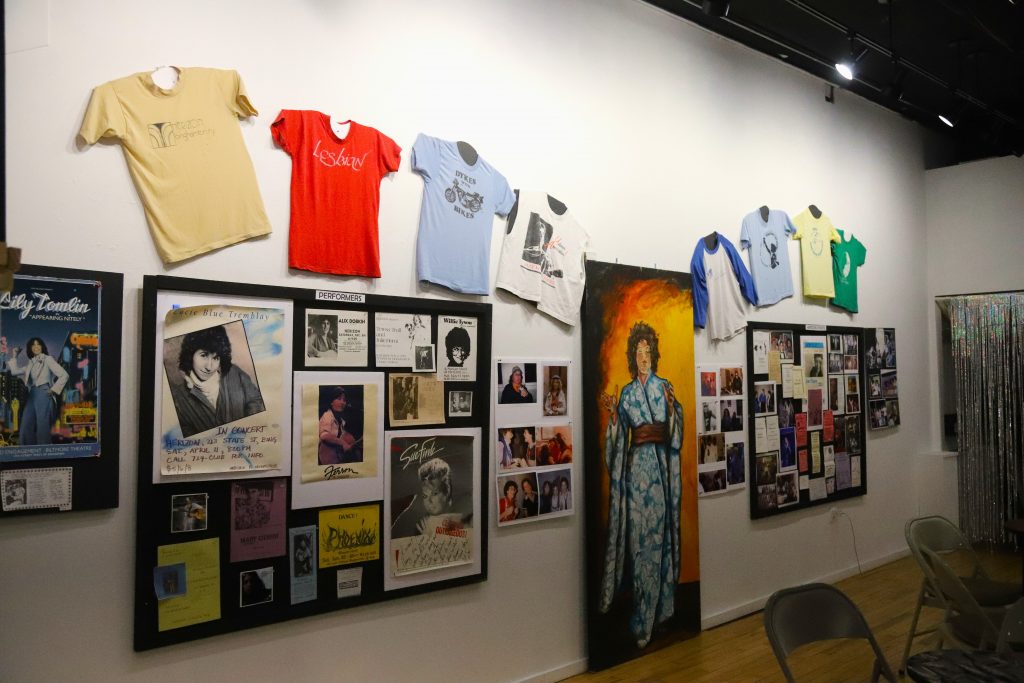
An exhibition at Cooperative Gallery 213 commemorating the 50th anniversary of the opening of Herizon, a private lesbian social club, closed last Saturday after being open since Sept. 5. The club was founded in 1975 at 77 State Street and later relocated to 213 State Street, the current location of the gallery.
With a peak of over 300 members, the social club was run by volunteers who wanted “a safe space for women, lesbians and supportive straight women to gather without risk of harassment and violence” during a hostile period for those groups both in Binghamton and nationally, according to the exhibition’s webpage.
This hostility was represented in parts of the exhibition, with documentation that relates to the persecution that lesbians and queer women faced in Binghamton. A newspaper clipping included in the exhibition from August 1930 mentions “two women, including one dressed like a man,” being arrested for their “suspicious clothing,” who lived as “husband and wife on Henry Street.”
The exhibition also included information about the lesbian community in Binghamton before the opening of Herizon. A reproduction of Herizon’s 10th anniversary newspaper recalls that by 1974, the sole lesbian bar in Binghamton, the Green Onion, was open for only a year before a bomb went off inside after closing, which the writer Laurie Ryan and others believed was done by an owner for financial reasons.
Despite the risks and dangers of operating gay bars in the first years following the Stonewall Riots in New York City, a lively queer nightlife emerged in Binghamton, offering space for both college students and locals. They were “all owned by men and some by the syndicate,” had a “frantic sexual and alcoholic atmosphere” and “overt” gayness was often repressed by management, according to Ryan.
However, these bars were an inextricable aspect of lesbian life. It was where women “found friends, lovers, and a sense of belonging in an otherwise alienating society.”
This exhibition depicts how essential spaces like Herizon were then and continue to be today. Walking through the recreation of its front door, painted chalkboard black with no way to look inside, the materials on display, including posters, flyers, T-shirts, murals, records and a section dedicated to Herizon members who have passed, illustrate what the space meant to its 300 members at its peak and the lives that they lived within it.
Walking around the gallery, looking at materials from Herizon, provided an emotional experience, both because of what the club was and its closure. While there are several options for lesbians and queer people in general in Binghamton, they are limited. It can be especially difficult for college students seeking community, as the constant turnover of the student body also applies to bars and community spaces in Binghamton.
There were several reasons that Herizon had to close in 1991, among them the devastation of the AIDS epidemic, but there also simply weren’t enough people willing to work and keep the space going.
According to the author and professor Bonnie Morris Ph.D ‘89, who studied women’s history at Binghamton University and was a member of Herizon, by the late 1980s, it was difficult finding enough volunteers to keep Herizon open from Wednesday to Sunday.
Many wanted to keep it open to provide a place where a member could drop in spontaneously to find “warm sisterhood and cold beer,” but with many members having “gradually paired off, settled down, bought homes, adopted kids, and/or elected to get sober,” there weren’t enough people nor funds to keep it open. This was exacerbated by the raising of the New York state drinking age to 21 in 1985, which prevented college students interested in the space from attending.
Members wanted the space to continue to exist without providing the necessary support to do so. Morris wrote, “They simply expected that women’s cultural space would continue to be available to them as consumers, without their taking a role in it as producers.”
There has been a massive decline in the number of lesbian bars and women’s spaces in the past several decades, with an estimated 24 lesbian bars in the United States in 2021, compared to over 200 in 1980. Several factors contribute to this, like online dating, greater social acceptance of queer people and gentrification that prices out bars.
But they also close because people stop going. While there has been a small revival of lesbian bars and spaces, the loss of Herizon tells a fundamental lesson that people can carry both while at the University and beyond: participation.
Morris says it best: “cultural space that is woman-friendly and queer-friendly does not just happen: it’s a product of hard-won compromise with location, labor, outreach, budgeting, and communication.” It is arduous, but it is necessary. Whether your involvement includes attending events at lesbian and queer bars, working behind the scenes or helping others find community, it is all vital.
Tip your queens and the bartenders, and relish the queers spaces you find and make — they need you as much as you need them.