





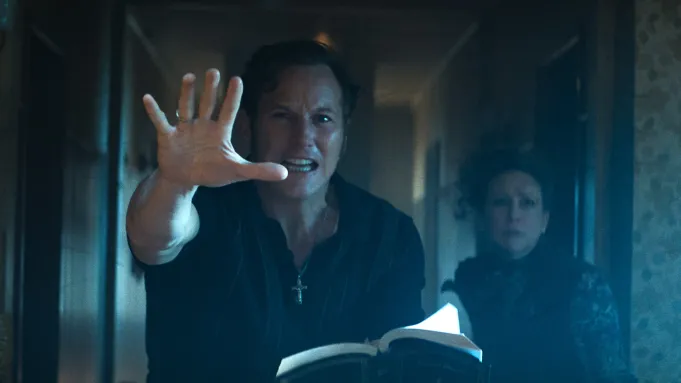
Released on Sept. 5, “The Conjuring: Last Rites” provided a palatable, satisfying ending to the current series with heavy familial themes and a focus on the Warren family.
Primarily set in the ’70s, “The Conjuring” franchise frames the narrative around a particular family experiencing a haunting, to which the Warrens, a paranormal investigation duo, are called to release the family from the entity. “The Conjuring: Last Rites” challenged the framework of the typical “The Conjuring” plot, as the family that is typically at the center of conflict fades into the backdrop of the Warrens’ personal experience with the central demonic entity.
With the use of interesting lighting, sound and a centralized focus on the Warren family, the film stands apart from the rest of the franchise.
Many of these stylistic choices were shown through the repeated transition into visions had by Lorraine Warren (Vera Farmiga) and her daughter Judy Warren (Mia Tomlinson). These transitions were depicted by a change in lighting, quickly engulfing the character in darkness and transforming an otherwise pleasant or neutral scene into something much more sinister.
Darkness is also used to obscure and distort faces, hinting at the influence of the demonic entity over the individual’s life. Conversely, great instances of light were used to highlight moments of joy — most notably the ending scene in which Judy marries her fiancé, who was introduced at the beginning of the movie and remained a central character throughout the film.
The film’s emphasis on lighting and darkness ties into the prominent overtone of Christian values, which are mostly displayed through the almost redundant calls to God in moments of despair and helplessness, alongside the central themes of familial bonds and Christian imagery.
Sound, or lack thereof, separated the movie from its predecessors, as most moments of tension and horror occurred in silence or unintelligible whispering. In previous “The Conjuring” movies, these scenes would involve screaming and loud crashes, at times disrupting the tension and breaking from the gravity of the scene. The choice to allow horror to occur in quiet spaces built tension throughout the movie and carried it into the following scenes.
A drawback to using prolonged scenes of silence was that it affected the pacing of the already extended run time. The two-hour-and-15-minute-long movie dragged, as much of the first hour was uneventful and could have been cut to fix pacing.
Additionally, the Warren’s characteristic investigative work was essentially cut. At the beginning of the movie, the audience was directly told of the connection between the Warrens and the other family, ultimately reducing viewer engagement in the plot.
Newer characters like Judy Warren, her fiancé and the family experiencing paranormal activity were all underdeveloped and were simply used to further the plot rather than exploring how they fit into the narrative. Many of these characters felt replaceable, which came at a huge disadvantage to the film, as Judy Warren coming into adulthood and earning a place in the family’s work was a central plot point.
On the other end, Farmiga particularly stood out from the cast, as her facial expressions often cued visions or acute perceptions of information and spiritual connections. Seeing Lorraine step into a standalone role — outside of her identity as half of the Warren family couple — in the franchise was entertaining as Farmiga’s acting range came through.
Although the film wasn’t particularly exceptional, it served to give the series a positive ending and was an overall entertaining watch.
Rate: 3/5