





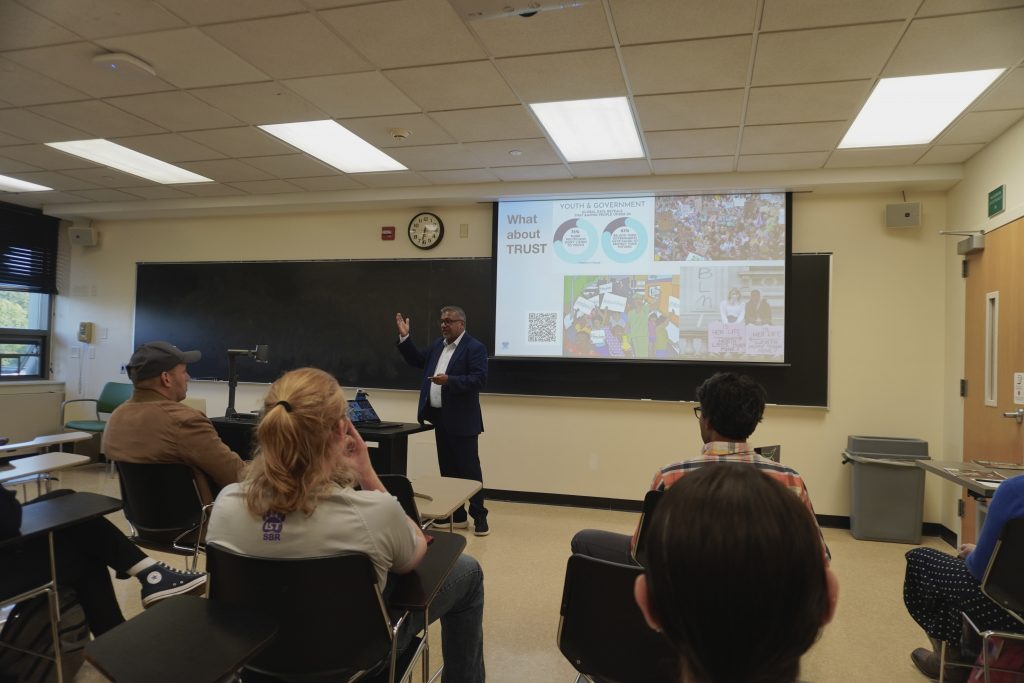
The Institute for Genocide and Mass Atrocity Prevention kicked off this semester’s visiting practitioner program with a talk by Lakshitha Saji Prelis, a distinguished advocate for youth involvement in peacebuilding.
Held on Thursday, the panel, “The Unexpected Gift of Conflict: How Intergenerational Trust Powers Transformative Change,” centered around the potential for intergenerational cooperation to transform conflict into opportunities for change. It was the first of three public presentations that I-GMAP plans to host as part of its visiting practitioner program, where atrocity prevention practitioners visit the Greater Binghamton area for one week and engage with students, faculty and the local community.
Prelis is the director of children and youth programs at Search for Common Ground, an international conflict transformation organization. He has 25 years of experience in leading global efforts to build intergenerational collaboration and trust in over 35 countries, successfully co-leading advocacy for three United Nations Security Council resolutions calling for youth needs to be centered in conflict mitigation. In 2017, he received the Luxembourg Peace Prize for Outstanding Peace Support for his work.
“Young people, people in their teens and twenties, play a really key role in promoting human rights and in building more peaceful, more just societies around the world,” Kerry Whigham, founding co-director of I-GMAP and an associate professor of public administration, said. “And that’s a really important message for our students to hear, especially because it shows that all over the world, young people and students have been key in transforming societies and making them more just and more peaceful. Hopefully that’s something that can inspire students today, when we’re living through some really difficult moments nationally, but also globally, when it comes to human rights protections.”
The panel began with a land acknowledgement honoring the Oneida and Onondaga nations. Prelis then opened the talk by discussing his upbringing in Sri Lanka, a country that suffered through civil war from 1983 to 2009.
During this time, Prelis explained that he witnessed both the horrific atrocities and courageous acts humans carry out during conflict. He described watching one of his friends be killed during the conflict, which led him to choose not to avenge his murder. These experiences led Prelis to become an advocate for conflict resolution.
Prelis highlighted the importance of viewing conflict beyond the surface level to grow, reflecting on how it can be an “unexpected gift.”
“If you only see the conflict as an ugly thing that is dangerous and bad, then you’re only going to see more bad things,” Prelis said. “But if you see the silver lining in it, no matter how ugly it might be, then we are able to also see through these processes and see the possibilities as well.”
Prelis also compared conflict to a controlled fire that can awaken individuals and prompt them to focus on crucial societal issues. When conflict turns violent, however, it can spiral and become detrimental to society.
During the talk, Prelis listed areas where the median age of the population was younger than 20, like Sub-Saharan Africa, where the median age is 19, and the Sahel region of Africa, where the median is 15, both as of 2023. He then highlighted a large gap between these medians and representation in government, saying that only 2.7 percent of government officials worldwide are under 30. This can create discrepancies in perspectives between the population and the government, he said.
Prelis explained the importance of interconnectedness, arguing that youth voices can be built in a network with other aspects of society. Despite their differences, all people across different demographics and age groups desire an improved society and can work together with a shift in understanding, Prelis said, and that these coalitions will grow stronger as trust is built over time.
When asked by Pipe Dream how young people can implement these ideas into the local community, Prelis outlined four things for students to keep in mind: they should highlight the youth aspect of the issue; welcome discussions with older generations; recognize that change and trust building do not occur overnight; and the importance of laying the groundwork for change.
“The door you open today, more people will come and continue to open and widen [the door] and open the windows in the room for more people to benefit from it,” Prelis said. “Your legacy is making sure the door is open for the others to come after you.”