





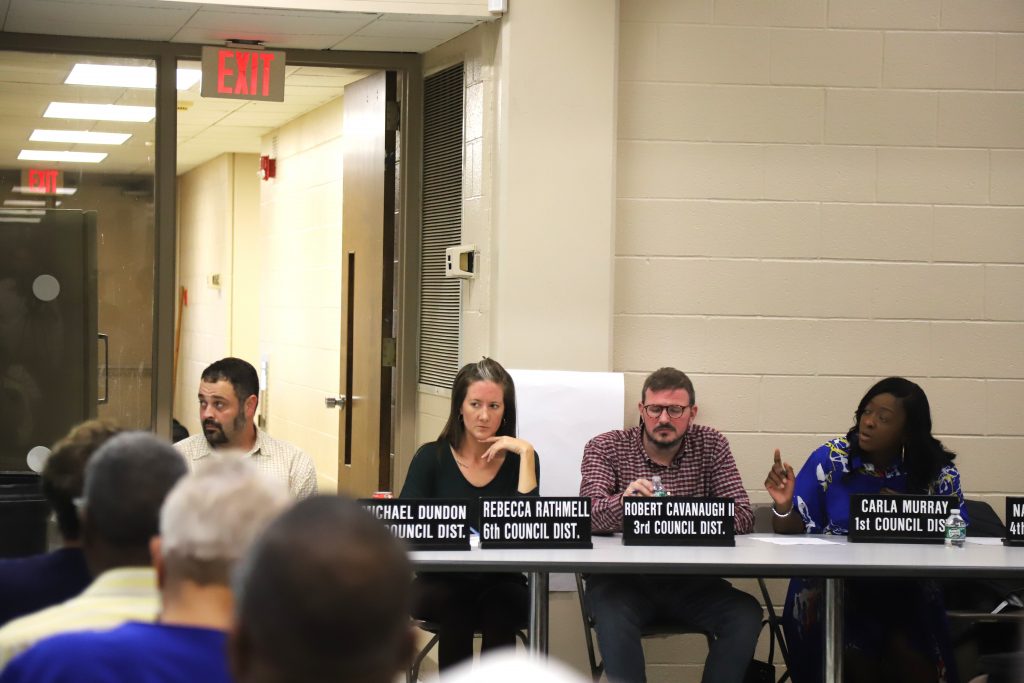
At a tense town hall meeting on Tuesday, community members debated whether Columbus Park in the City of Binghamton should be renamed.
The town hall was hosted by the Broome Tioga chapter of the NAACP and held in the Recreation Center next to the park. Members of the Binghamton City Council, Associate Dean of Decker College Sharon Bryant, Broome County Historian Roger Luther and former city Mayor Richard Bucci attended the town hall.
The NAACP requested a reexamination of the park’s name after the organization asked residents for their opinion on renaming the park. At a Juneteenth event held in Columbus Park, the NAACP asked attendees to fill out a brief survey. After an organization meeting in July, the organization sent that same survey out via a listserv.
Of the respondents who filled out the survey on Juneteenth, 79 percent expressed support for renaming the park. These findings contrasted with the survey results overall, which showed that 52 percent of all respondents opposed a name change.
At the town hall, Bryant presented the survey’s findings, which included an option for respondents to select a new name for the park. Potential names included Billie Anderson, a local civil rights activist who passed away in 2023; Assata Shakur, an activist and member of the Black Liberation Army; and some location-based names like Binghamton Community Park.
Harold Wheat, a South Side resident, supported a name change. He read a quote by Bartolomé de las Casas, a Dominican friar who, in 1542, described the hardship faced by the indigenous people as the Spanish conquered islands in the Caribbean.
“’The Spaniards still leave nothing save to tear the natives to shreds, burn on them, and inflict upon them untold misery, suffering and distress,’” Wheat quoted. “’Tormenting, harrying and persecuting them mercilessly. By some accounts on the island of Hispaniola, there were several million people when Columbus arrived; he had established several colonial administrations.’”
“By the end of his life, there were less than 1,000 by some accounts,” he continued. “That, by all accounts, is genocide.”
Wheat’s statement elicited strong opposing responses from some community members.
As of 2023, 16 states officially recognize the second Monday in October as Columbus Day. In 1990, South Dakota became the first state to officially recognize Indigenous Peoples’ Day. New Mexico, Vermont, Maine and Washington, D.C. renamed the holiday to Indigenous Peoples’ Day in 2019. Two years later, Joe Biden became the first U.S. president to issue a proclamation recognizing Indigenous Peoples’ Day on the same day as Columbus Day, honoring the “immeasurable positive impact” that Indigenous peoples have on American society.
In the early 2000s, only 25 states and the District of Columbia observed Columbus Day. California and Delaware stopped officially recognizing the holiday in 2009.
“Columbus had become synonymous with the Italian American immigrant experience,” Bucci said at the town hall. “The journey was not easy for Italians — they faced hardships, prejudice, discrimination and even exploitation. They were at the bottom of the social scale, and menial jobs were the ones most commonly only available to them.”
“As the son and grandson of Italian immigrants, I learned firsthand of the trials and tribulations of their experience,” he continued. “During these struggles, Christopher Columbus became a symbol of pride and achievement.”
Luther presented his research on the history of the park’s surrounding area and its importance to the Black community. Luther said a 1938 study of the city showed that 55 percent of the African American population lived in the area near what is now Columbus Park. The park was originally named Caroll Street Playground after the site of School No. 8, built in 1845 as the city’s first school for African American students.
The park was expanded in 1926 and renamed to Sherman Place Park before returning to its original name two years later. However, in 1955, the park was expanded and reopened in 1959 as the Christopher Columbus Park. Luther said many residents in surrounding areas were displaced in the 1960s because of urban renewal projects.
In his closing statement, Rev. Damond Wilson, the Broome Tioga NAACP president, said it was important to have the local area reflect the identity of all the people who live there. He emphasized the importance of community and the impact a name truly representative of the area’s residents can have in his closing statement.
“If we take this opportunity to actually work together as a community, I feel like we can do something great,” Wilson said. “I feel like we can change the trajectory of not only history, but having a way of changing the trajectory of young people’s lives.”