





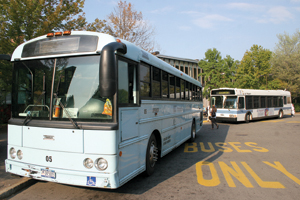
Because of a 24-year-old tax error, Off Campus College Transport has been placed in a difficult position: regain legal status by Oct. 10 or be shut down completely.
Though OCCT has been functioning as a not-for-profit organization at Binghamton University since 1984, it was discovered three years ago that a necessary tax-exemption form had never been filed.
According to Elaine Liu, the OCCT Service Manager, the mix-up has made it impossible for BU to legally contract with OCCT.
The service usually receives $9 per student from the Student Association, and a portion of the $47 transportation fee every student pays as part of their tuition, according to Matt Landau, president of the SA. Because of the legal problems, however, money from the transportation fees can no longer go to OCCT.
“For the past year and a half the SA has been footing the bill, and now we can’t,” Landau said.
As a result of last year’s deficit, OCCT is currently in debt of approximately $40,000.
According to Liu, an SA lawyer filed an IRS application for tax exemption last week for OCCT. If it goes through, the OCCT will again be eligible to make a legal contract with BU.
The lawyer estimated on Sept. 4 that the process will take between one and six weeks, or a little longer, Landau stated.
“This is an issue that has to do with the administrative end of OCCT,” Liu said. “Passengers don’t deserve to be affected and the administrative end should make sure they aren’t.”
A memorandum originally made by former SA President Mike Smyth in the 2005-06 school year stipulated that the University would give the SA around $230,000 to pay for OCCT. This agreement wasn’t renewed by former President David Bass, however.
“He wasn’t willing to make an agreement because it would put the executive board under personal risk if there was an accident,” Landau said. “The president of OCCT could be held legally responsible, as could the administration.”
The University is committed to providing reliable and cost-effective transportation service to students, according to Brian Rose, vice president for Student Affairs.
“We are working with the SA and OCCT to resolve the legal and equipment issues,” he said.
Though Landau had previously considered a contingency plan which would suspend some bus routes and keep others, he has since decided to make Oct. 10 the deadline to avoid unnecessarily changing bus schedules.
“If OCCT is legally compliant [by Oct. 10], then the buses stay, if not, there’ll be a complete shutdown,” he said.
If legal status isn’t achieved by approximately Oct. 3, then “maybe we’ll shut down all but campus shuttles to buy more time,” Landau added.
Such a contingency plan could involve cutting all weekend buses as well as trips to the Oakdale Mall and other non-essential locations. Students would need to utilize city buses instead.
“This new plan is great for the next month,” Liu said. “However, I don’t have control over whether or not we’ll get tax exemption status, so it’s a gamble either way.”
“If we have to stop service completely it would be a huge loss for the students,” she added.
Though OCCT is not currently laying off any drivers, this situation means fewer shifts and less work for them, according to Liu. Seventeen student drivers have already been denied a raise this year.
“I would really hope the SA would think of us as a priority and really help us out in any way that they could,” said Regina McCormack, a driver for OCCT. “If we have to cut service that would just be terrible, and I wouldn’t want to think how bad that would be for so many students.”
There is a 50/50 chance that OCCT will become legally compliant by the deadline, according to Landau. He remains optimistic about the outcome, however.
“I don’t think we’ll have to shut down buses,” he said. “But if we do, it probably wouldn’t be for longer than one to two weeks.”