





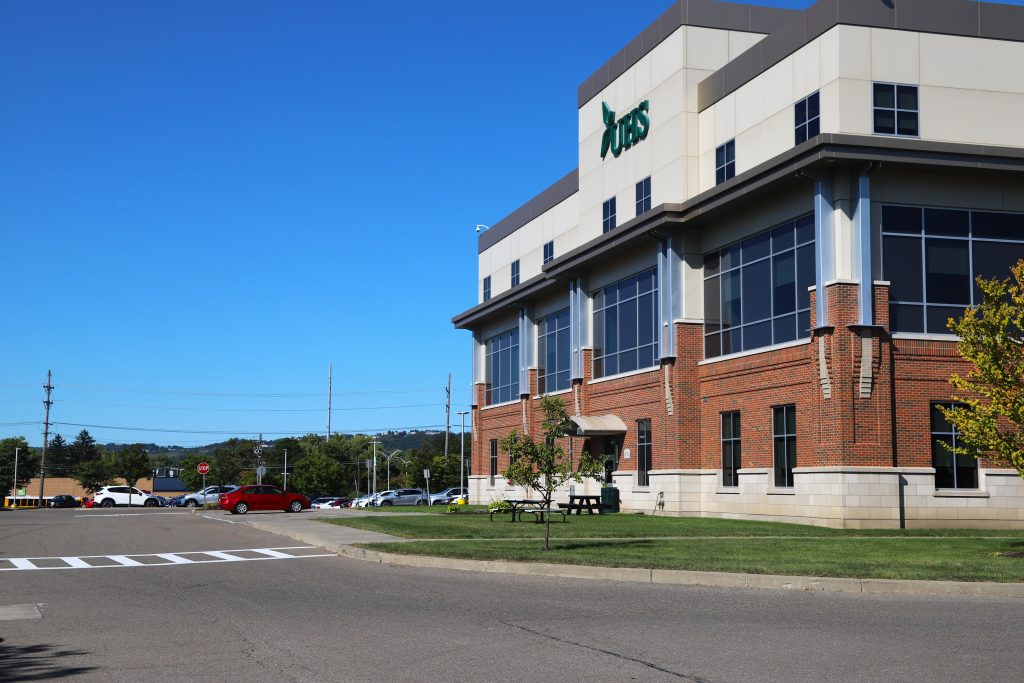
The United Health Services Pediatrics Binghamton team recently earned a Broome County Immunization Champion award for achieving the highest adolescent immunization rate in the county and educating the community about preventative care and public health.
In 2021, the Broome County Department of Health and the Broome County Adult Immunization Coalition created the awards to recognize organizations that have successfully promoted vaccinations in Broome County. The award reflects a clinic’s immunization rate and spotlights its efforts in prioritizing patient health and contributing to community well-being. Clinics that achieve the highest pediatric or adolescent vaccination rate and those nominated for promoting immunizations are eligible to receive an award.
“The goal of recognizing Immunization Champions is to celebrate the hard work they put in to keep Broome County healthy, and to inspire others to take creative approaches to improve immunization coverage,” wrote Chelsea Reome-Nedlik, supervising public health educator at the county’s health department.
The childhood immunization rate is determined by the number of patients who were given their 4:3:1:3:3:1:4 series routine vaccines by their second birthday, Reome-Nedlik wrote. The series includes four doses of the diphtheria, tetanus and acellular pertussis vaccine; three doses of the polio vaccine; one dose of the measles, mumps and rubella vaccine; three doses of the Haemophilus influenzae B vaccine; three hepatitis B vaccine doses; one shot to protect against varicella, or chickenpox; and four doses to protect against Streptococcus pneumoniae.
Meanwhile, the adolescent immunization rate measures how many adolescents have received one dose of the Tdap vaccine; a shot of meningitis protecting against serogroups A, C, W and Y; and a vaccine protecting against human papillomavirus by their 13th birthday.
Vaccines protect individuals and communities through a medical phenomenon known as herd immunity, which occurs when most of the population develops immunity to a disease. Herd immunity lessens the possibility of a pathogen infecting vulnerable individuals and spreading within the population Vaccines have played a vital role in reducing or even eradicating a plethora of once-prevalent diseases in the United States, including measles, polio and smallpox.
The Centers for Disease Control and Prevention estimates that childhood immunization, specifically, prevents approximately four million deaths each year. Despite this, approximately 14 million children under the age of 1 remain unvaccinated today.
In recent years, the conversation around vaccinations has become increasingly contentious, as the U.S. Health and Human Services Secretary Robert F. Kennedy Jr. has cut $500 million funding for mRNA vaccine research and directed the CDC to no longer recommend COVID-19 vaccines to healthy children and pregnant women. He also fired the CDC’s entire 17-member Advisory Panel on Immunization Practices.
On Sept. 4, Kennedy defended his decisions at a U.S. Senate Finance Committee hearing. Bill Cassidy, a Republican senator from Louisiana and a medical physician, criticized Kennedy for his recent policies and claimed that they will result in denying people access to vaccines. Some members expressed concerns about Kennedy’s dismissal of Susan Monarez, the CDC’s director, after she spent only a month officially in office. A group of senators serving on the committee, all of whom are Democrats, criticized Kennedy.
The county health department has worked with local healthcare organizations to host vaccine education events for the public. Among these is a “Teddy Bear Clinic” event, held at local libraries for children to understand what to expect when getting a vaccine.
“For most of those who work in public health or healthcare, the incentive to perform well is the well-being of their patients or community,” Reome-Nedlik wrote.