





Amid confusion over federal funding for the Supplemental Nutrition Assistance Program, local politicians and community members are trying to support those in need through alternative funding sources and volunteer organizing.
With the federal government shutdown in its second month as of Nov. 9, 42 million Americans who receive SNAP benefits, including over 26,000 Broome County residents, are left uncertain if or when they will receive full food assistance. As a result, food banks across the Southern Tier are preparing for a spike in demand. At Binghamton University, the Center for Civic Engagement, the Food Pantry and the Social Work Undergraduate Union launched a food drive last week.
On Sunday night, the U.S. Senate voted 60-40 to advance the Republican-backed spending bill that would end the shutdown. The House of Representatives, which has been out of session since Sept. 19, must approve the legislation then send it back to the Senate for final approval. A vote on the measure is expected later this week.
On Oct. 30, Gov. Kathy Hochul announced a state of emergency and Broome County Executive Jason Garnar ‘99 followed suit the next day. Hochul pledged an additional $65 million in state aid for emergency food assistance.
“There is no local or state program that can truly replace it,” Garnar said at a press conference. “But while we cannot replace SNAP, we can and we will do everything possible to help people get through this very difficult time.”
At an Oct. 31 press conference, Mayor Jared Kraham said cutting SNAP funding was a crisis on par with “a national disaster or public safety emergency,” adding that many families “are going to be without it, the way that things look right now.”
“People who are going to be suffering because of this may unfortunately be suffering in silence,” Kraham said at a press conference. “They may be not reaching out for help. Now is not the time to have that happen. It’s a time to check in on neighbors. It’s a time to support our great nonprofits at the Food Bank and [the Community Hunger Outreach Warehouse], who work on these issues year-round.”
As a part of the county’s emergency response, the Broome County Sheriff’s office transferred $200,000 from a trust account to fund 14,000 emergency meal boxes. In a statement to Pipe Dream, Broome County Sheriff Fred Akshar said food security was an “essential component” of community safety, adding that he “could think of no better way to spend this funding than to feed our community’s children.”
“In Broome County, we work together in times of crisis, no matter our political differences,” Akshar said. “All our leaders in Washington could learn from Broome County’s ability to work together to help those who need it most.”
The U.S. Department of Agriculture sent a letter to state agencies on Oct. 10 warning that if the government shutdown continues, the federal government may not provide SNAP benefits in November. Last week, two federal judges blocked the administration from completely suspending SNAP benefits. On Tuesday, White House Press Secretary Karoline Leavitt said the administration would be “fully complying” with the judicial rulings and plans to partially fund the program.
Her comment came hours after Trump posted on Truth Social that SNAP benefits “will be given only when the Radical Left Democrats open up government, which they can easily do, and not before!”
The Trump administration asked the U.S. Supreme Court to temporarily pause the federal district court ruling requiring the full distribution of SNAP aid for November. On Friday evening, the Supreme Court granted the administration’s request but noted that its injunction will expire 48 hours after an appeals court decides whether to place a hold on the ruling while it hears the case.
Assemblywoman Donna Lupardo MA ‘84 described the Trump administration’s actions regarding SNAP funding as a “wholesale failure to govern” and that Trump’s “lack of involvement” in ending the government shutdown was “inexcusable.”
“Vulnerable people should never have been put in such a precarious position in the first place,” Lupardo said in a statement to Pipe Dream. “Other funds could have been tapped to avoid this disruption altogether. Now it’s unclear how long it will even take for this relief to arrive on people’s EBT cards.”
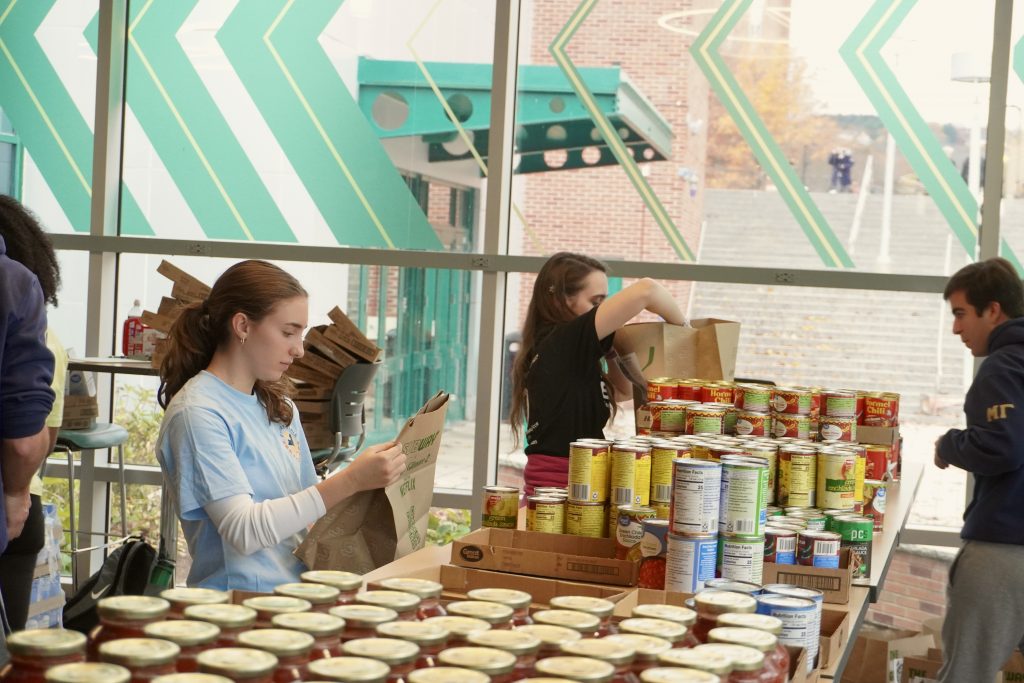
On Friday, the CCE and SUNY’s Empire State Service Corps, a paid public service program for students, prepared over 500 meal kits for community members in need through the University Food Pantry and the Broome County Council of Churches. An estimated 30 student volunteers helped assemble the meal kits.
The event, held in the University Union’s Fireside lounge, addressed Hochul’s call for a day of hunger action for service corps members. Volunteers assembled bags of canned foods with recipe cards, each containing easy-to-make dishes like green chicken chili, casseroles and minestrone.
“Our focus is how we can bring the resources of the University and student interest in volunteering to address the increased need that we’re seeing in the community,” said Alison Twang ‘11, MPA ‘13, Ph.D. ‘22, director of the CCE.
Ren Longo, a member of the Empire State Service Corps and a first-year graduate student studying speech-language pathology, said they attended the event out of concern for potential SNAP benefit cuts, knowing how effective they are at reducing hunger.
From Nov. 7 to Dec. 5, the CCE will also hold a food drive in collaboration with the Food Pantry, the University’s Office of Fraternity and Sorority Life and students from the Department of Social Work. Donated food and personal hygiene items can be dropped off at bins placed around campus.
“This is a serious challenge, but it’s one we’ll face together as one community that takes care of its own,” Garnar said at the Oct. 31 press conference. “Broome County has been through hard times before, and every time, we’ve come through by looking out for one another. That’s what we’ll do now.”