





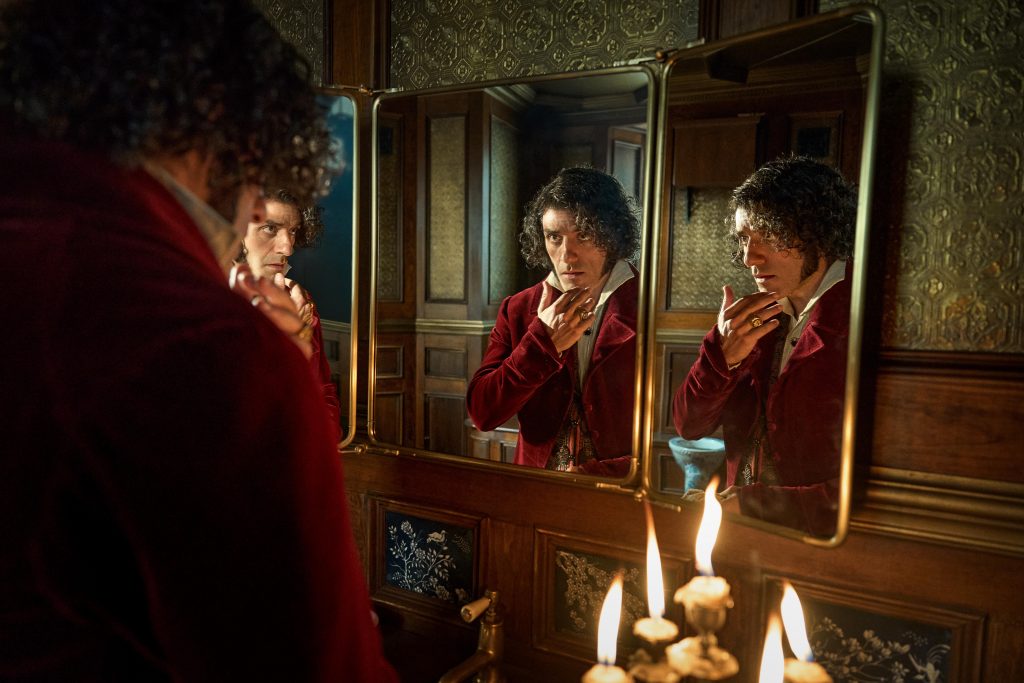
It’s alive, it’s alive! “Frankenstein” has been reintroduced to the cultural zeitgeist — this time streaming on Netflix. When it was announced that the modern king of monsters, Guillermo Del Toro, was taking on Mary Shelley’s gothic horror legend, expectations were set high. Being faithful and ingenious with such an influential literary character carries a massive burden, and despite shaping the story under a more modern lens, Del Toro exceeded the standard.
The latest entry on the “Frankenstein” timeline is complete with a star-studded cast of today’s biggest names. Oscar Isaac plays the iconic mad scientist Victor Frankenstein, parallel to Jacob Elordi, his towering creation. Mia Goth (Elizabeth Lavenza and Claire Frankenstein) and Christoph Waltz (Henrich Harlander) are just some of the other heavy lifters in the ensemble.
The story orbits around the centerpieces of Elordi and Isaac, who excel in the roles they’ve been given. Isaac’s Dr. Frankenstein is charismatic and hopeful to start, transforming gradually into the brooding husk he resembles by the end of the film. On the other hand, Elordi’s Creature is layered and melancholic, staying true to the soul of Shelley’s original creation. Although the relationship between the Creature and the doctor is framed slightly differently in Del Toro’s reimagination, Elordi and Isaac do a good job of bringing that vision to life.
The “Frankenstein” movie is broken up into two main acts. Following in the footsteps of Shelley’s original novel, the first half of the story trails Victor Frankenstein as he narrates his early life and experiences reanimating the monster. The second focuses on the monster, who learns what it means to be human as he’s confronted with the cold reality of his world. The story structure is nearly identical to Shelley’s, with only a few key details undergoing massive change.
While this review will not divulge any massive spoilers, the film’s conclusion leaves a more hopeful and wholesome taste in the viewer’s mouth. It felt like a true-to-form modernization of the source material in both tone and presentation, marked by Del Toro’s signature fantastical style.
Where Del Toro transcends the horror genre is in his distinct and memorable visual style. This is ever-present in “Frankenstein,” which is chock-full of grand set pieces and magical visuals that stand out from the duller colorations and darker moods that are native to the genre. The world of “Frankenstein” feels like it was built for Del Toro in this sense, allowing him to give a spin that feels both fresh and at home in the narrative that he is working with. Colors are vibrant and bright, and every major set piece is delicately constructed with Del Toro’s intricate attention to detail.
This is a passion project for the legendary horror director and this fact oozes out of every frame. Not many horror directors can make a world feel as lived-in as this one, and it improves every aspect of the film entirely.
As with any reboot, it’s important to ask whether or not the movie made valuable contributions to the source literature without disrespecting or undermining the messaging at the center of the story. Del Toro makes valuable contributions, but it can certainly be argued that Shelley’s original decisions were more in line with the tonal intent of the narrative.
Despite this, Del Toro deserves a commendation for his creative foray into the realm of gothic literature. With horror becoming more popular and less one-note, this iteration in the “Frankenstein” universe is a gem of modern horror adaptations. Over 200 years after the publication of Shelley’s original masterpiece, Del Toro reanimated the character to its former cultural stature in his own way.
With a truly contemporary reinvention of the source material, Del Toro navigates a difficult responsibility with tact and ease. The legendary director releases another entry, cementing him as a genre great.
Rating: 4/5