





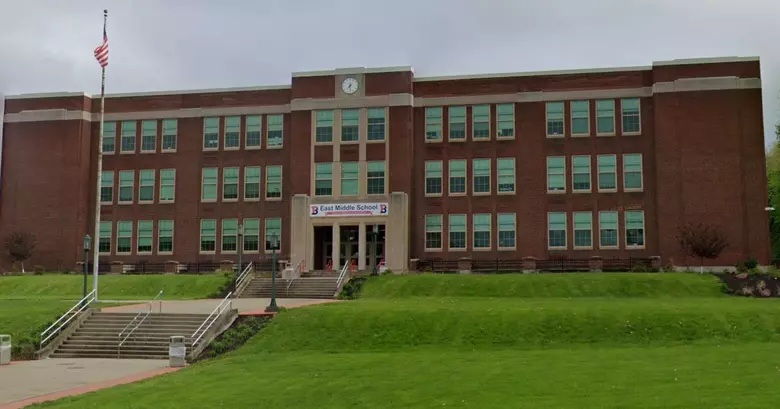
A federal appeals court ruled in favor of the Binghamton City School District over a 2019 incident where four middle schoolers were allegedly strip searched for suspected possession of an illegal substance at the city’s East Middle School.
The case, first filed in the U.S. District Court for the Northern District of New York, was litigated for five years before a federal judge ruled in favor of the school district and its staff members in August 2024. The lawsuit alleged that the four girls, all students of color, were apprehended in school by principal Tim Simonds while walking in the hallway. They were then escorted by Simonds and assistant principal Michelle Raleigh to Mary Eggleston, the school nurse, who then searched each girl without notifying the students’ parents or guardians, conducted a sobriety test and searched the girls’ belongings.
In the original complaint, the plaintiffs claimed that the students’ constitutional rights were violated — particularly their Fourth Amendment rights, which protect against unreasonable search and seizure. They also claimed the searches were motivated in part by the fact that all four girls are Black and Latina, which violates the Fourteenth Amendment and Title VI of the Civil Rights Act of 1964.
In 2020, Judge Glenn Suddaby authored an opinion dismissing many of the plaintiffs’ arguments but allowing their Fourth Amendment claims to continue. The NAACP Legal Defense Fund and a multinational law firm filed an amended suit in 2021. In February 2024, the district court once again ruled in favor of the school district, dismissing three of the girls’ Fourth Amendment claims and found insufficient evidence to determine their equal protection rights were violated.
However, Suddaby ruled that Eggleston’s search of one of the students, identified as I.M., “greatly exceed[ed] the scope” of the others and allowed her claim to move forward. That July, I.M. “agreed to dismiss that claim with prejudice but preserved her right to appeal the district court’s summary judgment ruling as to her other claims.”
“The court’s decision confirms what the district has said from the beginning: that the employees acted in accordance with the constitutional rights of students and acted on information to maintain the safety and best interests of its students,” the school district wrote in a press release following the 2024 ruling.
On Aug. 9, 2024, the plaintiffs’ attorney from the NAACP appealed the district court’s summary judgment ruling on their Fourth Amendment claims. Last month, after over a year of litigation, the United States Court of Appeals for the Second Circuit ruled that “no reasonable jury could find that the challenged searches were excessively intrusive.”
The appeals court affirmed the district court’s determination that the students’ Fourth Amendment rights were not violated and cited case law supporting the idea that “Fourth Amendment rights are different in public schools than elsewhere.” The court also held that a “standard of reasonable suspicion, rather than probable cause” should be applied in cases involving student searches — any search must be “reasonably related to the objectives of the search and not excessively intrusive.”
The ruling maintained that the Binghamton City School District had reasonable grounds to search the students. According to the court, the school district was concerned about students possibly ingesting a “purple juice,” or lean, consisting of cough syrup, candy and soda that caused various symptoms. On the day of the incident, the plaintiffs allegedly disappeared for several minutes and were found in an “unsettled state,” leading the court to conclude the school district acted reasonably when searching for possession of a prohibited substance.
The appellate decision went on to affirm that the searches were not excessively intrusive. Each student was first given a sobriety test, patted down and then asked to empty their pockets and remove their shoes, which the court found was justified to check for possession of prohibited substances.
Two students, I.M. and A.S., alleged they were illegally strip searched. As I.M. dismissed her case against Eggleston with prejudice and could not prove that the other officials were involved in the search, her claim was rejected by the court. As for A.S., the court maintained that a brief unzipping of her sweatshirt was not “excessively intrusive in light of the age and sex of the student and the nature of the infraction.”
The actions of the school district sparked outcry from the local community. In the weeks following the incident, the Progressive Leaders Of Tomorrow organized a rally outside of the East Middle School, calling for the school officials to resign. The rally drew considerable media attention, leading then-Gov. Andrew Cuomo to order the New York State Education Department to lead an investigation into the matter.
“The ruling further diminishes the rights of students, especially women and students of color in Binghamton schools, by allowing invasive searches that leave young people distressed and feeling powerless against school officials’ authority, while normalizing the invasive treatment of children under the guise of security,” the Thurgood Marshall Pre-Law Society wrote in a statement to Pipe Dream. “While we recognize the important duty that schools hold in ensuring campus safety through adherence to school rules, this ruling grants schools the authority to go beyond searches of outer clothing, creating unchecked power that threatens students’ dignity and bodily autonomy, which is particularly egregious in cases where no violation is ever found.”
The NAACP Legal Defense Fund declined to comment on the ruling. The Binghamton City School District did not return Pipe Dream’s requests for comment.