





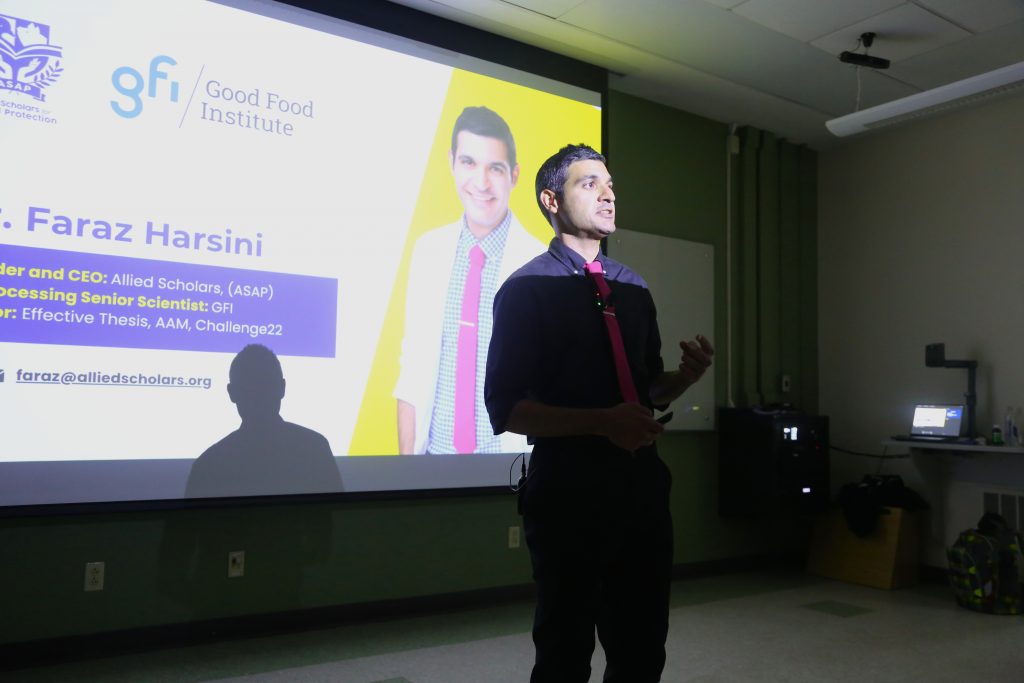
Dr. Faraz Harsini, founder and CEO of Allied Scholars for Animal Protection, delivered a lecture at Binghamton University last Thursday about the realities of the animal farming industry and why students should adopt a vegan lifestyle.
Hosted in collaboration with the University’s Allied Scholars chapter, the talk centered around Harsini’s career and advocacy for veganism. During his speech, Harsini said he became an advocate for animal rights and veganism after realizing that a plant-based diet is both good for the individual and society. He argued that switching to a vegan diet could not only help combat climate change, but also greatly reduce deaths from chronic diseases such as heart disease and cancer — the two leading causes of death in the United States.
Before Harsini founded the organization and became bioprocessing lead scientist at the Good Food Institute, he was a biomedical research scientist focused on cancer. Throughout his career as a biomedical scientist, he constantly asked himself, “Is this the best you can do? Is there nothing more impactful? Is that it?”
This drive to do more, combined with his desire to help others, led Harsini to continue his education in cancer research at Texas Tech University after graduating from the University of Tehran in Iran. His research in developing therapeutics for cancer, influenza, COVID-19 and other zoonotic diseases was deemed an extraordinary contribution to U.S. science and he was granted residency.
Harsini’s shift to food systems and vegan advocacy came with the realization he made with the words of a friend — that he was a “hypocrite.” His friend pointed out that many of these issues he cared about, including the diseases he was studying, are linked to meat production and consumption.
“Previously, I was interested in environmental issues,” Harsini said in an interview with Pipe Dream. “Then I became interested in biomedical issues, like cancer and chronic diseases and then I realized that a lot of times, they’re actually correlated with the food that people are eating and no one is talking about that.”
“So about 40 percent of cancers, according to UK Cancer Research, can be prevented,” he continued. “Heart disease is the number one cause of death and it highly correlates with higher saturated fat and cholesterol consumption. So, saturated fat consumption is the number one cause of heart disease, so when I saw that, I was like, ‘I need to focus on the root cause,’ which is the food that people are eating.”
Harsini said in his talk that animal rights is “today’s biggest blind spot” and the “most neglected form of oppression.” He argued that the issues he faced growing up as a gay man in Iran, where oppression against LGBTQ+ people was commonplace, receive far more media and public attention than animal cruelty in industrial farms like concentrated animal feeding operations.
Harsini explained that he would have been executed in Iran for coming out as gay as well as not being religious. Meanwhile, he argued that society turns a blind eye toward the killing of animals due to our current societal beliefs about meat consumption and “Ag-Gag” laws lobbied by the meat industry, which seek to punish would-be whistleblowers for undercover investigations of the animal farming industry.
“No one really says that I should be executed for who I am, right?” said Harsini. “But we still think that animals should be killed because we like cheese. And so to me, this becomes one of the biggest, most neglected — that’s the word — the most neglected forms of injustice.”
Veganism, Harsini argued, is the only viable option. He claimed that certain marketing techniques, such as advertising products as “cage-free” or “pasture-raised,” spread misinformation.
College students, Harsini said, can have an “exponential impact” on the food system because they are open-minded and have their whole career ahead of them.
“I think that students today are future leaders,” Harsini said. “Students are thought leaders. I think that students are young, they’re open-minded. The whole idea of being in a university is because you’re here, because you want to learn new things, because you want to be exposed to new ideas. It’s here in universities where we form a lot of our identities.”
Following the talk, there was a brief Q&A session with Harsini. Free vegan pizza and refreshments were provided.
Last Wednesday, ahead of the talk, the University’s chapter of ASAP led a demonstration on the Spine where members of the club held televisions displaying a looped video of farm animals being slaughtered. The demonstrators wore masks while other members of the organization engaged students on the Spine in discussions about exploitative farming practices and switching to veganism.
In an interview with Pipe Dream, Benjamin Aronson, the ASAP chapter lead and a senior majoring in mathematics, said the talk was thought-provoking, particularly when Harsini talked about how much land is used for animal production.
“One thing he didn’t mention is that we grow a lot of plants to feed animals, very inefficient calorie transfer,” Aronson said. “If we fed all those plants to humans that we feed animals, we could feed 10 billion more people.”