





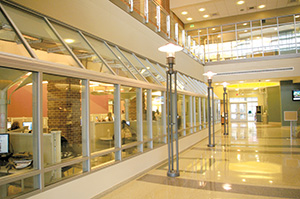
Finishing off its second school year, the University Downtown Center has heard some praises.
Located at 67 Washington St., the facility houses Binghamton University’s College of Community and Public Affairs.
“At first, people were shocked because of the change of moving off campus. People complained about not being prepared for the change and rebelled,” said Jodi Epstein, president of the Human Development Association, which is a student group. “Initially there was some dissatisfaction with the center. Currently we have essentially no issues and the problems were remedied as quickly and effectively as possible.”
According to Epstein, these problems were solved and, since then, the UDC has had a lot to offer.
“There have been a lot of positive changes to the UDC,” said Epstein, a junior human development major. “Despite the difficult transition the [University Downtown Center] has become a great asset to the University.”
According to Patricia Ingraham, the dean of the College of Community and Public Affairs, the classes held at the UDC are determined by decisions made by the University Registrar’s Office. Classes have been placed in the UDC due to crowding issues on the main campus at BU.
Provost Mary Ann Swain made the decision.
Classes at the UDC are typically chosen under three simple criteria, according to Ingraham.
They must be upper division, not have a lab requirement and, due to scheduling restrictions at the Downtown Center, these courses must last three hours.
“I am quite pleased with things at the Downtown Center,” Epstein said.
The center, Epstein said, holds the majority of courses offered for human development majors.
“Human development was moved to the Downtown Center to have students closer to the community, which is what the major is about,” Epstein said.
Epstein also said the UDC is parallel to a small community.
“The Downtown Center works like a small community; everyone is very warm and friendly,” she said, “There are a lot of areas to study with friends and have group meetings.”
Ingraham also commends the UDC for its wealth of academic benefits.
“The Downtown Center has wireless capabilities, flexible classrooms for discussions and group experiences and the building is also eco-friendly by taking advantage of the natural light for heating and lighting the building,” she said.
Sarah Khan, a junior human development major, said she is “very happy with the Downtown Center; I have had no complaints and the professors are really engaging.”
Kristina Rose, a senior art history major, was also very positive about the UDC.
“The organization of the classrooms was excellent,” she said. “The desks were sort of rounded, which made it nicer to interact with the teachers and students.”