





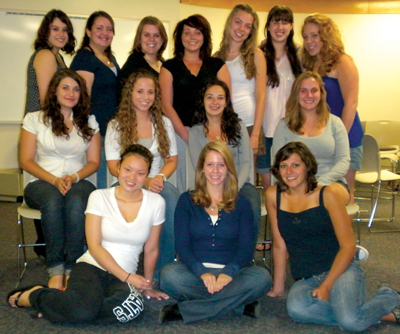
A group of women engineers are banding together on campus in an effort to provide support for the limited number of females looking to enter the field.
Alpha Omega Epsilon, a women’s engineering sorority, is in the process of getting their official charter and is currently considered a colony on the Binghamton University campus, according to President Kate O’Connor.
O’Connor said that the group started in her freshman year when she and a group of girls got together and looked into the sorority.
The group acheived colony status last spring after participating in networking and philanthropic events and hosting social events, along with other activities aimed at professional sororities. Colony status means the group is recognized by their national headquarters as part of AOE and only has a certain amount of tasks left to complete before being recognized as a chapter.
The group’s faculty advisor, Sharon Fellows, who is also a female working in a technical field, has played a significant role in getting the organization started.
“Right now we’re just kind of finishing paperwork,” O’Connor said. “Hopefully by the end of the semester or the beginning of next we’ll achieve chapter status.”
The group started with 10 colony founders and recognizes a total of 14 chapter founders, including the four pledges from last semester.
Vice President Samantha Meyerholz said that although there is a co-ed engineering fraternity on campus, she and the other founding members felt it was important to have one just for women.
“It’s really hard to go through engineering without support,” Meyerholz said. “We just want those girls to stay with it.”
O’Connor added that the sorority aims to give women an entire “class of friends” to go to.
She and Meyerholz are undergraduate course assistants for a freshman engineering course and both said that in each of their sections there were two women and more than 20 men.
The sorority, which is looking for four or five pledges for this semester, was established on a national basis in November of 1983. There are now 21 chapters in the United States and Canada.
O’Connor said that girls are always outnumbered by guys.
Meyerholz added that it can make the classroom somewhat uncomfortable. “They [the chapters] all started for the same reason,” Meyerholz said.
According to the organization’s Web site, the group’s mission statement is to “further the advancement of female engineers, while at the same time developing bonds of lifelong friendships.”