





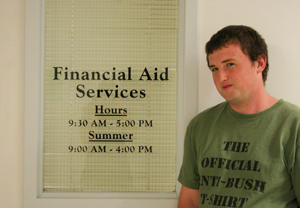
Members of the Binghamton University community are debating over which presidential candidate could provide the best economic state for students.
According to Brian Young, president of the College Democrats, most students at BU would have their taxes cut if Sen. Barack Obama wins the presidency.
The Web site for Barack Obama, the Democratic candidate for president, states that the candidate’s economic policy, called “Making Work Pay,” seeks to provide lower and middle class families with a tax credit that will lower or even eliminate income taxes for nearly 10 million Americans.
However, John Jensen, president of College Republicans, said he feels that Obama would cost students more in the long run.
“The funding for those tax cuts is just not there,” Jensen said. “It’s not the government’s responsibility to take care of us all economically.”
According to Jensen, Obama’s policies would create a negative job climate, make it difficult for businesses to hire workers and negatively affect recent college graduates, especially business students, such as those from the BU School of Management.
“To raise taxes and punish businesses for doing exactly what they’re supposed to do — make money — is exactly what we don’t need,” he said.
City officials have expressed their concern that the current economic crisis on Wall Street will make finding student loans and jobs to pay for college extremely hard.
“The way it is now, it’s a bad situation,” Matthew Ryan, mayor of the city of Binghamton, said. “Fewer and fewer people can afford to attend college without stacking up huge amounts of debt.”
According to a Sept. 17 report in The New York Times written by Tamar Lewin, college students are seeking federal financial aid in record numbers this year.
“Pell Grants may need up to $6 billion in additional taxpayer funds next year,” Lewin wrote. “As of July 31, 800,000 more students had applied for grants than on that date last year.”
Barmak Nassirian, associate executive director of the American Association of Collegiate Registrars and Admissions Officers, called the amount of need yet unfulfilled “the mother of all shortfalls.”
“There’s more unmet need than anyone predicted,” Nassirian said.
According to the Financial Aid Office on campus, 76 percent of students attending BU are on some form of financial aid, 69 percent of which is need-based.
Kenneth Christianson, an economics professor at BU, said he believes it would be easier for students to get grants and scholarships under a Democratic administration, and more loans under a Republican.
Young was confident that a package underneath Obama would be the better deal for students.
“The government keeps cutting our federal aid packages,” Young said. “With the Obama administration, he will actually understand what we go through. He understands what it’s like to struggle whereas John McCain’s in the pocket of the big lobbyists.”
The Obama campaign states on its Web site that it intends to “mandate that all federal student loans be provided through the direct loan program.”
Sen. McCain’s Web site shows his policy on Financial Aid for students is a continuation of the Federal Direct Student Loan Program, the umbrella program for financial aid created by the Clinton administration in 1993. The program involves a multitude of financial forms coupled with loans from private banks.
McCain has pushed to guarantee that state agencies serving as lenders of last resort for students have enough money, according to Jensen.
“McCain has pushed the importance of educating the American people and is a supporter of student loans that are easy to access for students,” he said.
Dennis Chavez, director of Financial Aid at BU, said the school has chosen to stay with direct lending.
“The terms of the loans are exactly the same,” Chavez said. “I’ve heard the arguments on both sides.”
According to the U.S. Department of Education, funding for the Federal Direct Student Loan Program has continuously decreased over time from over $100 million to over $62 million since 2006.
“Democrats have always supported increased funding for public schools, while Republicans have consistently believed in charter schools and consistently taken positions against funding public schools,” Young said.
The recent crisis on Wall Street has been branded as one of the worst financial crises since the Great Depression, causing voters to evaluate how it will affect the economy as well as their tax dollars.
“About 20 percent of New York state tax revenue just comes from Wall Street,” Christianson said. “One of the things Gov. Patterson argued this [last] weekend was that when Lehman Brothers collapsed, we lost a billion dollars in revenue. If the state’s losing that much more tax revenue, the state’s going to see more budget cuts for SUNYs.”