





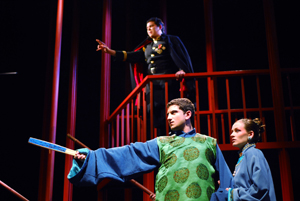
Eastern acting techniques were mixed with classic Western literature as a group of Binghamton University students premiered an nontraditional performance of “Romeo and Juliet” last Friday.
With the help of director Chen Lincang from the National Academy of Chinese Theater, BU’s production of Shakespeare’s “Romeo and Juliet” differed from customary versions of the play.
“[Binghamton University] is very interested in educating students in the world of theater,” said Gwendolyn Schwinke, assistant director and voice coach for the show’s cast. “It is a great experience to experience theater from other cultures.”
The actors worked with Lincang for six weeks in the hopes of learning a different approach to studying theater. One acting concept that performers at BU use is called Inside-Out, which requires actors to teach themselves the text and the meaning of each word.
“You find the soul of the text before you put each word into movement, such as … movement compared to the other characters on stage,” said Leanne Mercadante, who plays Juliet in the play.
But Lincang taught the performers to work with the opposite concept, Outside-In, which is when the actors must first memorize the text by heart. Then the movements are brought to the stage.
“You use movement to find the heart of the meaning of each word,” Mercadante explains.
One cast member in particular, Mallory Schlossberg, who plays the role of Juliet’s nurse, used the Outside-In acting technique a great deal.
“My character had a very specific movement and characterization. For example, my character’s feet were bound,” she said, adding that the technique helped her to find the certain manner in which her character moved, and the meaning behind it.
A character’s movement isn’t only indicative of his or her lines, but of a larger story within the work, according to the show’s stage manager Brian Goldblatt.
“In Beijing opera each movement tells a story in itself, that is why Chen made sure that each movement the cast made was so exact and specific,” he said.
Unlike the typical opera that many Americans associate with singing, Beijing opera is more like Western theater play, with some modifications.
The Chinese version of “Romeo and Juliet” is told in a more innocent manner. Many of the lines were cut because the BU version was adapted to Chinese culture.
“We even experienced the Chinese culture firsthand with Mr. Chen and the manner in which he critiqued us,” explained Lee Garrett, who plays Romeo.
Lighting and color issues also marked the crossing between the two cultures. Because in Chinese culture the most beautiful colors are black and red, the stage was decorated in both shades. Besides the cast members having difficulty with the adjustments, it also “took a very long time for the lighting staff to understand the cultural changes of light,” Goldblatt said.
Although the cast had to do some tweaking for certain differences, communication issues weren’t as prominent. There was a translator for the entire cast so they could communicate with Chen, but some students said the director’s emphasis on movement continued beyond the stage.
“His body language is incredible and you know exactly what he wants. Sometimes I felt that I did not even need the translator to understand him,” said Mary McCarthy, who plays the apothecary.
The show will be performed again this Friday and Saturday at 8 p.m. and this Sunday at 2 p.m. All shows will be held in Watters Theater in the Fine Arts Building. The price for student admission is $8; the price for faculty, staff and seniors is $12; and the price for the general public is $14. To purchase tickets, visit theatre.binghamton.edu or call (607) 777-ARTS.