





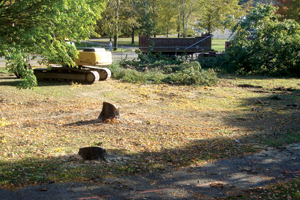
The construction of a new parking lot on campus has sparked discontent among several faculty members at Binghamton University.
Lot T, which is scheduled to be completed with 80 spots by early December, is located between Johnson and O’Connor Halls of Dickinson Community. Construction began on Oct. 8, and nine trees were cut down on Oct. 9, during the Yom Kippur break, to clear space.
According to Richard Andrus, a professor in the environmental studies department, the campus environmental community only found out about the planned construction on Oct. 8, when members of the Committee on University Environment (CUE) walked through the lot.
“The bulldozers were already warming up,” Andrus said.
According to Andrus, the trees could have been cut down when students were on break so they wouldn’t be bothered, but the timing also could have been to prevent students from protesting the construction.
Julian Shepherd, a professor in the biological sciences department and member of the CUE committee, said that construction workers agreed to save some trees and eliminate two parking spots when it was suggested during the walk-through.
According to BU spokesperson Ryan Yarosh, a notice was sent out campus-wide via Dateline and B-Line on Oct. 7. The creation of the lot was also noted in a February 2008 article in Inside BU.
“In March, an Environmental Assessment Form was distributed to CUE committee and several other parties, and in that form creation of the parking lot was outlined,” he added.
The form stated that there would be no parking lots built till 2011, according to Andrus. However, Yarosh said there was an oversight or error in that document.
“The EAF did note a 2011 date for parking but did not include the date for Parking Lot T1 though creation of the spaces is described,” Yarosh said.
Andrus and Shepherd said that parking lots bring a host of environmental problems. They said the lots destroy green areas, increase runoff, heat up the planet and don’t allow any filtration.
“All these little things that people are doing add up to a big impact on the environment,” Shepherd said.
There are more benign ways to build parking lots, according to Andrus, particularly if the idea is to minimize impact instead of saving costs. Andrus said using porous asphalt and putting in devices to decrease runoff are two such methods.
Andrus said he was told that the lot is being built because of demand from faculty and students. Neither he nor Shepherd think that more parking was necessary, however.
Peter Knuepfer, a professor in the geological sciences and environmental studies department, agreed.
“I have to wonder if there is a demonstrated need for a parking lot at this time,” Knuepfer said.
According to Andrus, the handling of the issue calls BU’s reputation as a green campus into question.
“Are we a green campus or not?” he asked. “What is the commitment of the administration if at a relatively flimsy excuse, we start cutting down trees?”
But Yarosh said that the University is sensitive and committed to reducing negative environmental impacts on campus.
“The landscaping plan for the first building of the East Campus Housing project includes planting of approximately 28 large deciduous trees, 38 evergreen trees and 42 small deciduous trees,” he said.
He also said that there are countless energy savings projects completed, underway and planned. The University has transformed 81,860 square feet of formerly paved areas to green space as part of Operation Green Space over the last five years, according to Yarosh.
The question, according to Andrus, remains: “What the hell is a ‘green campus?’”