





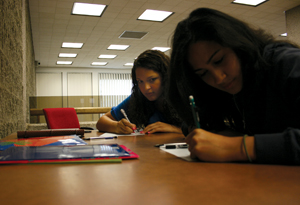
It’s a tempting crime. Statistics suggest that it is also an easy crime. Most have at least thought about it — looking over their neighbor’s shoulder and copying an answer — but most of us resist the urge to cheat. Or do we?
Statistics on the prevalence of cheating from a variety of sources, ranging from academic studies to collegehumor.com, may surprise some. Even though it carries with it harsh penalties, cheating is still common.
“There appears to be some increase in academic dishonesty in recent years,” said Julia Miller, assistant dean of Binghamton University’s Harpur College of Arts and Sciences. “Instructors are reporting more cases to the Harpur College Academic Honesty Committee and students are signing more admission of dishonesty forms.”
A study done by The New York Times revealed that two-thirds of students will admit to cheating.
Professor Howard G. Brown doesn’t need a study to be convinced that cheating is on the rise, however.
“I don’t have any statistical proof of this, but I firmly believe that cheating and plagiarism have increased in recent years,” Brown, who is the history department chair, said. “This is due to the easy availability of information via the Internet, larger class sizes that make students more anonymous and assignments more uniform, and greater competition in the struggle to succeed.”
David Clark, the chair of the political science department, said that he believes there may not be an increase. Instead, professors have simply gotten better at recognizing cheating, and this creates the illusion of increased numbers.
“I think we have gotten much better at catching it, so it appears that there is an increase,” Clark said. “I don’t really think it’s different than 10 years ago.”
While the pervasiveness of cheating may not have a clear-cut source, it is safe to say that technology has likely played a part in the increase.
Technology might make it easier for people to cheat; thousands of essays are available on the Internet for would-be plagiarists. However, technology has also made it easier for instructors to catch cheaters with systems like turnitin.com, a program that uses a statistical analysis of non-original content.
“Many of my colleagues in the history department require their students to send their papers and assignments to www.turnitin.com,” Brown said. “Other faculty simply attempt to overcome the rising numbers by continuing to meet individually with each student to develop original paper projects, thereby learning about the student’s depth of knowledge and preparation to write the paper.”
Clark tailors his assignments to specific topics in the classes he teaches, making it harder to find ready-made answers online. He also “googles” sentences that look odd.
“I think it deters a lot of people just to say, ‘Turn it in to turnitin,’” he said.
Academic dishonesty can have stiff penalties, both within the University and for students wishing to continue their education.
“The penalties for plagiarism or cheating range from receiving no credit for the relevant portion of the course, to receiving an F for the entire course, to being expelled from Binghamton University for at least a semester,” Brown said. “The last option is the official policy of Harpur College for manifest plagiarism.”
Instructors have a few options to choose from when dealing with plagiarism and cheating.
“Honesty violations can be addressed by instructors. Instructors can also ask students who are first-time offenders to sign a letter admitting to cheating or plagiarism, or they can refer any student to the Harpur College Academic Honesty Committee. Students can also bring cases to the committee,” Miller said.
“Students found guilty by the Committee of Dishonesty face penalties that range from probation to dismissal from the University, depending on the seriousness of the violation,” he added.
One instance of cheating stands out in Brown’s mind.
“In the past, some students have been foolish enough or desperate enough to turn in papers that have whole sections cut and pasted from Internet sources, including leaving the underlined hyperlinks in the paper,” Brown said. “In that case, I had the two students come before the entire class, sign a form acknowledging their misdeeds and formally accept an F for the course.”
Brown did this publicly because he feels that plagiarism or cheating is an offense against fellow students who worked for their grades.
“Awarding course credit and eventually an actual degree to students who have not acquired that same knowledge or skills debases the value of the course credit and the degree as well,” he said.