





Last year Binghamton University students and faculty managed to break a University-wide record for most printed paper in an academic year, and the administration is attempting to curb the trend.
Last year, PODs printers rolled out 11,730,437 printed sheets of paper. This year, by just the third week of classes, students and faculty had printed 374,712 sheets of paper, a sign that students are already ahead of pace to break that record this year, according to James Wolf, director of academic commuting services.
Wolf added that BU’s printing has been increasing at a rate of 10 percent every year.
‘We have to educate people to conserve resources,’ he said. ‘We advertise ourselves as a green campus.’
Wolf said the printers are usually working their hardest when students are preparing for finals. At that time, he said, BU has reached more than half a million sheets throughout all of finals week.
‘If I could change the way the print system worked, I would make it so that people would have to pay out of their own pocket in order to print,’ he said. ‘I think there would be less printing, and that would keep our percent increase from going up every year.’
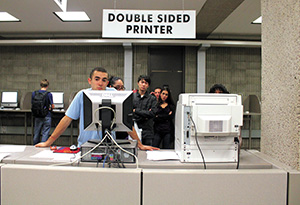
Currently BU has only five double-sided, or duplex, printers, which is 13 fewer than the number of simplex printers. Wolf said the intent is to add more duplex printers, but only when another printer breaks.
‘We were afraid that with something more mechanically complex, the probability of having jams would be higher,’ he said. ‘When we do get more, we’d also like to set the duplex printers as the default print setting.’
Hyo Kim, a senior majoring in environmental chemistry, said she was astounded when she heard how much paper the campus has printed this past year.
‘Students do not realize how much their printing is impacting the environment,’ she said. ‘The worst part is looking into the recycle mania bins and seeing unused documents thrown away.’
Kim said she thinks the quota system lets students know how much paper they can use, but said that it does not help students keep track of how much they are printing.
Kim, who is also the environmental project coordinator of NYPIRG, said the organization is currently working on a project for the Science Library which will display a nine-foot cardboard tree on the wall.
‘The total area of the tree is directly proportional to the amount of trees in the Nature Preserve,’ Kim said. ‘Every week we will remove a piece of the tree depending on how many pages are printed on campus that week.’
The idea is to see how long it takes to deplete all the trees in the Nature Preserve.
‘By having this on display, we hope to reach out to frequent printers and work together to reduce our waste,’ she said.
Kim said students should cut back on actions such as printing readings and syllabi. He suggested reusing ‘sheets that students abandon in the PODS’ and printing only sections of documents that are absolutely needed.
‘Each page printed accounts to toner waste, paper waste and electricity used to run the printers,’ Kim said. ‘This multiplied by 11 million adds up to so much, especially when it’s happening in a progressive and intelligent community.’
But Wolf thinks BU students can change the future of PODS printing.
‘There’s a reminder on the computers to think before you print,’ Wolf said. ‘Don’t print just because it’s there. We need to have students want to be green for this to be a green campus.’