





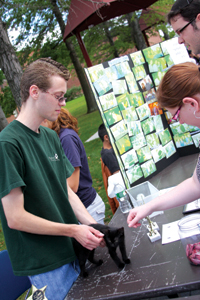
The Pre-Veterinary Society at Binghamton University is committed to providing a support circle for veterinary school applicants, who are faced with competitive odds at fewer than 30 schools around the country.
According to Sam Stewart, the club’s president, the Pre-Vet Society was formed to help students choose classes, fill out their applications and organize trips to nearby universities with veterinary schools, including Cornell University and University of Pennsylvania.
“It’s a support group for pre-vet majors,” said Marsha Fiesinger, vice president of the society. “We get speakers from vet schools and we do a lot with animals.”
The organization meets Thursdays at 6 p.m. in room 252 of the Old University Union to discuss upcoming trips and events. According to Stewart, there are currently about 30 active members, but they are still recruiting.
“This is for anyone who is interested in animals,” Stewart said. “You don’t have to be a science major.”
Vet school admission is so competitive because there are only 28 vet schools in the country, and each only takes 80 to 100 students annually. Therefore, to get in, an applicant needs to have good grades, lots of experience working with animals and over 1,000 hours of work in a vet’s office, Stewart said.
The club also helps people find jobs and volunteering opportunities at shelters, zoos and stables in the area. Members have had internships at the zoos in Binghamton and Syracuse, as well as jobs at horse conservation sanctuaries in Africa.
“There are always new opportunities and things to get people involved,” Stewart said.
Some volunteers assist in Stable Movements, a non-profit facility which helps mentally and physically disabled children using hippotherapy and therapeutic riding.
Horseback riding provides mental stimulation for the children because they are in charge of caring for the horses, and as they ride around their muscle strength and balance improve.
“We’ve seen big improvements in a lot of kids,” Stewart said.
Stewart and Feisinger said that another successful project for the society was caring for an alpaca. Ann Merriwether, a professor in the psychology department at BU, and her husband have a farm where they raise alpacas and sell the wool for clothing.
A year ago a cria, or baby alpaca, was born with a tumor. Ordinarily it would have been euthanized, but instead the Merriwethers took it to Cornell and had the tumor removed. The operation was costly and the alpaca lost the use of its legs.
The Pre-Vet Society sent volunteers to do therapy.
“I used to go twice a week last semester,” Fiesinger said. “It’s rewarding because this semester we’ve heard that he’s doing a lot better.”
There is a great demand for large animal vets, according to Stewart, who said that it’s extra work because the patients can’t communicate, so it’s difficult to determine what’s wrong.
“This means that if you want to be a vet for dairy farmers, you’re easily accepted into vet school and they pay your way for you,” he said.
Additionally, it is hard for small farmers to afford vet care.
“The unfortunate thing about many practices is that it’s more about money than care,” Stewart said.
But Stewart said the Pre-Vet Society is more care-focused, and many of its members intend to open free clinics in the future.
“Working with animals is a rewarding experience, and animals are very important in today’s society,” Stewart said. “The Pre-Vet Society wants to better the world for humans and animals.”