





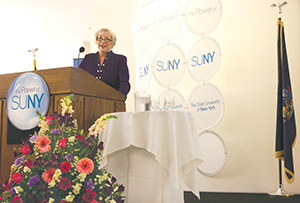
SUNY Chancellor Nancy Zimpher launched the final version of her SUNY strategic plan Thursday to a packed hall in Binghamton University’s Old University Union.
The plan aims to improve educational opportunities afforded to students in SUNY schools, as well as encourage widespread community development and economic revitalization throughout the state.
According to Zimpher and Carl Hayden, chairman of the SUNY board of trustees, the strategic plan was first conceptualized after budget reductions cut $424 million from the SUNY system over the last two years.
Hayden said the reduction in funds could begin to have long-term effects on SUNY. A lack of investment, he said, ‘will eventually push you beyond the tipping point, and the decline that occurs after that is often irreversible.’
Calling Binghamton University ‘one of the crown jewels of the SUNY system,’ Hayden also emphasized the need for SUNY to compete on the global stage with other renowned universities, while also contributing to the economic development of the state.
Zimpher, her colleagues ‘ who created the plan ‘ and Hayden said that these goals would not require any additional funding from the state. The plan would build off of Gov. David Paterson’s Higher Education Empowerment and Innovation Act. The Act would give campuses greater control over their assets and more flexibility in setting tuition rates.
‘Let this university free,’ Hayden said. ‘Let the regulatory straitjacket off the State University of New York.’
Nicknamed ‘The Power of SUNY,’ the new strategic plan comprises six major themes or ‘big ideas’ that Zimpher plans to use to guide the SUNY system as it develops over the next decade.
The six themes included greater emphasis on entrepreneurship, increased education for teachers and expanded education for health care professionals. They also include encouraging energy efficiency, fostering stronger campus-community relationships and improving SUNY’s relations with universities around the world.
Although the majority of the new strategic plan is geared toward the growth and development of the local economies and communities of New York, Zimpher reiterated her dedication to the students at Binghamton University and the other SUNY schools.
‘What matters the most are the students ‘ all 464,981 of them,’ she said.
Several of the proposed initiatives outlined in the six big ideas include plans for new service-learning and entrepreneurship programs, as well as new and improved study abroad programs.
SUNY spokesman David Henahan highlighted one initiative, called SUNY Works. In this program, undergraduates would be granted paid, credited internships during the semester at various businesses and industries in the local community to provide ‘a two-way learning experience’ and to foster a more seamless transition from college into the workforce.
Though many who are in favor of the SUNY strategic plan were present at Thursday’s launch, advocates for research assistants at the SUNY Research Foundation were also present. The advocates passed out fliers detailing how the Research Foundation and Zimpher had hindered the research assistants’ wish to a unionization vote, a fair contract and a more appropriate distribution of funds.