





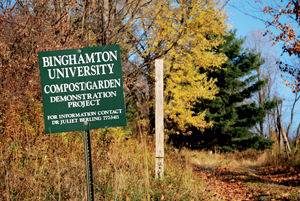
In an effort to grow food that is healthy and sustainable, a group of students and faculty has been maintaining an organic garden located off Bunn Hill Road.
“The main purpose is to produce food in an ecologically sustainable manner,” Mary Davis, a student volunteer, said. “It’s also important to note that the garden isn’t just organic — it’s local.”
According to Davis, the local food movement is a huge combination of efforts aimed at reducing the average American’s carbon footprint, or the amount of pollution a person is responsible for producing. Produce bought in the supermarket travels an average of about 1,400 miles, so it uses up a lot of gasoline, thereby emitting significant amounts of carbon dioxide into the atmosphere in the process. If more food were produced, sold and bought locally, Davis said, it would greatly minimize the impact food consumption has on the environment.
“The organic garden on Bunn Hill is a great example of small-scale, sustainable agriculture that anyone could do in their backyard,” she added.
The garden is located on Binghamton University-owned property. According to Richard Andrus, a professor in the environmental studies department, it was created because of students.
“As a student living in Hillside, the garden is just a 15-minute walk up Bunn Hill Road, so it’s a very convenient location for me,” Davis said. “I would guess that its proximity to campus makes it convenient for everyone else as well.”
According to Davis, the garden is not run by a specific group on campus, but volunteers are mainly members of the Student Environmental Awareness Club (SEAC) and the Campus Climate Challenge.
Minimizing the negative impacts on the environment is one of the chief objectives of organic gardening.
“We use no fertilizers, pesticides or herbicides, so the garden doesn’t contribute to the pollution of the Susquehanna [River],” Davis said. “That’s significant, since the Susquehanna flows into the Chesapeake Bay, and agrochemical pollution in the Chesapeake is a major issue.”
The methods used in organic gardening are also intended to maintain the soil quality. According to Andrus, one way to do this is to replenish the supply of organic material, or compost, which volunteers both make and receive from other sources.
Davis said this year’s harvest was particularly successful.
“This fall we harvested potatoes, leeks, tomatoes, onions, watermelons, green beans, green bell peppers, apples, pears and some herbs as well,” Davis said.
According to Andrus, nothing from the garden is sold, but instead, everything is divided between students.
This fall, each student volunteer took home a portion of the harvest.
“I cooked and ate what I brought home,” Davis said. “I had a great time and it made me wish I could plant a garden of my own outside my dorm room.”