





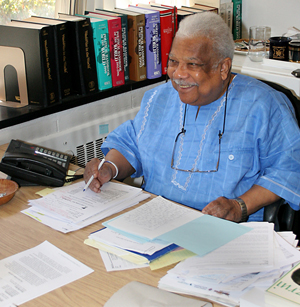
Ali Mazrui, Ph.D., a professor at Binghamton University and an African scholar, was recognized by Ohio Wesleyan University last night when he received an honorary degree of Humane Letters. Officials at Wesleyan have also asked Mazrui to speak at the school’s commencement in May.
Mazrui, who is a well-known scholar throughout the world, has been teaching at BU since 1989. He has lectured on five different continents and has won numerous awards.
During his commencement speech, Mazrui will be speaking about how the United States is the first universal nation that includes people from different races, cultures and countries.
In 1986 Mazrui published a video series, which aired on both BBC and PBS television channels, that looked back into the history of Africa and examined major influences on the continent, such as indigenous heritage, Western culture and the Islamic religion.
The video was one of Mazrui’s greatest achievements because of the large exposure it received.
“I was able to reach out to my largest audience yet,” he said. “Unlike my books, the video was able to be shown on television.”
The piece went into depth about Africa’s geography, history, anthropology and religions. Mazrui was able to interview people with different backgrounds including Africans, Middle Easterners and people from the Western world.
Aside from his academic work, Mazrui has also served on numerous committees, including the Council of African Advisors for the World Bank, because of his reputation as an independent African thinker. The goal of the council was to improve the conditions of Africa.
He also served on a council that dealt with the proliferation of nuclear weapons in the Middle East. One of the issues that the council investigated was whether Israel was making nuclear bombs. Because the different countries were represented on the committee, the issue was a heated topic.
“As chairman of this council, I had to make very difficult decisions,” he said. “There has been a spread of nuclear weapons in the Middle East and this issue has become very serious.”
Mazrui received his bachelor’s with distinction from Manchester University in England. He then graduated from Columbia University in New York with his master’s, and later obtained his doctorate from Oxford University in England.
After being educated at Oxford, he served as head of the department of political science and dean of faculty of social science at Makerere University in Uganda until 1973. In 1974 Mazrui went to teach at University of Michigan where he later served as director of the Center for Afro-american and African Studies until 1981. Today he serves as the Albert Schweitzer professor in humanities and director of the Institute of Global Cultural Studies at BU.
“There were several debates about me and my beliefs. I had very radical views on the United States and other countries,” Mazrui said. “Now people understand me better as a person and my views.”
Mazrui’s colleagues say his work over the years sets him apart from others.
“Although I have read Dr. Mazrui’s works for over 20 years and have only known him for six years, he is such a well rounded man,” said Seifudein Adem, Ph.D. “His writings and lectures cannot be compared to anyone else’s works.”