





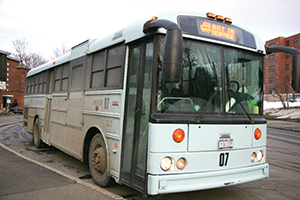
The Student Association introduced its proposal for major changes to the structure of Off Campus College Transport in order to save the bus company at Monday’s meeting.
“This is a critical point [for OCCT] as a company,” said Giovanni Torres, service manager for OCCT. “It cannot continue to run as it has the past 39 years.”
Torres and SA President Adam Amit drafted a plan to ensure long-term sustainability for the bus company, which includes financial and infrastructural changes, as well as a restructuring of the board.
As of right now, the company is slated to sink into paralyzing debt by 2013.
The proposal depends on a $6 activity fee hike per student for the year, to raise approximately $72,000 in revenue, which was approved by Assembly Monday. The hike will be brought to a student body vote in the upcoming weeks, although a date has yet to be set.
According to Amit, the SA has not increased the amount of money allocated to the OCCT operating cost in 11 years. Under the new plan an increase in funding will be voted on every six years, with a potential emergency option.
There is also the possibility that there will be a proposal to charge students $1 for late night service, from 10 p.m. to 3 a.m., in hopes of generating up to $20,000 annually.
Changes to OCCT’s board include the creation of a shadow chair member: a two-year position that in the second year becomes a voting chair. According to SA members, the position will be created so that there is an experienced member running the Board, and OCCT’s $1.5 million budget.
The proposal will be presented to the board of directors of OCCT at its meeting on Friday, and will tentatively be voted on at the following meeting on March 19.
The plan came a week after the board passed a vote to remove the Graduate Student Organization (GSO) from the board and to stop accepting financial contribution in the form of a GSO transportation fee, instead individually charging graduate students per bus ride.
Some OCCT drivers have mixed feelings about having graduate students pay for blue bus service.
“I’m opposed. It’s going to be a hassle and confusing,” said Jesse Vogl, a sophomore majoring in biology who has been an OCCT driver for two years. “The service is not just for undergraduates.”
Although the GSO will no longer contribute funding through a student donation, they are still required to pay the University transportation fee, which funds the campus shuttle that travels on campus, to the University Downtown Center and to the Information Technology Center.
Since they are still paying the University fee, graduate students will continue to ride the shuttles for free.
Under the SA proposal, non-student members of the community could potentially have access to the blue buses for a fee. The outline states for OCCT to act as a supplement to the BC Transit bus system.
“I think it opens up another can of worms,” said David Husch, director of Off Campus College and non-voting member of the OCCT board. “… No one wants to see the two combined. It is not what OCCT was built for.”
The SA and Torres hope that the increased funds from OCCT’s proposed changes, including a reduction in the number of buses that run at one time, and “in-house” maintenance on buses, will provide for future expansion and innovation.