





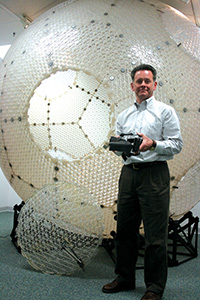
Imagine yourself in a firefight, surrounded by whizzing bullets or on a beach, taking a stroll and enjoying the serenity of waves rolling along the shoreline.
The best thing is, you can experience all these things without leaving Binghamton in the office of VirtuSphere, a local company whose beginnings are rooted in Binghamton University.
Created by brothers Ray and Nurulla Latypov, VirtuSphere is a unique, virtual-reality machine being distributed worldwide.
A BU professor and student are currently helping with designing and marketing VirtuSphere software.
Enclosed inside a 10-foot plastic ball, users wear virtual reality headsets to navigate a virtual world. Underneath the hollow sphere are wheels, which keep the unit stationary as they move in any dimension.
The machine has many purposes, from exploring to military training.
“Changing the purpose of use of this technology can be achieved with utmost ease as you simply reload the software to another virtual environment,” Mohammad Khasawneh, an assistant professor of system sciences and industrial engineering, said.
In 2005, the city of Moscow invited judges from the International Olympic Committee to explore a proposed stadium inside a VirtuSphere in an effort to bring the games to Russia, but lost the bid to London.
Khasawneh and the Latypov brothers are drafting a proposal for fund research for military training with the U.S. Department of Defense.
Their first plan was declined in 2008, but Khasawneh hopes to submit another draft by August.
“Since it would be difficult, costly, time-consuming and perhaps unsafe to train soldiers in the real world for complex scenarios,” he said, “using a realistic simulation based on virtual reality technology would be a safer alternative.”
Richie White, an MBA student, is collaborating with VirtuSphere’s marketing team through Professor Angelo Mastrangelo’s entrepreneurial project course at BU.
“Right now we’re really honing in on the defense-simulation industry, because spending in that area is up,” White said.
White said the biggest drawback of VirtuSphere is the lack of programs, but he remains optimistic about new applications being developed, such as “Virtual Iraq,” aimed at rehabilitating soldiers with post traumatic stress disorder. Albert Rizzo, a BU alumnus and research professor at the University of Southern California, wrote the program with one of his classes.
Jim DiMascio, chief operating officer of VirtuSphere, said that Ray Latypov started developing the technology in 1995.
“Between 1995 and 2003 he experimented with different prototypes, starting with a treadmill and ending up with the beach-ball look while experimenting with materials like fiberglass and polymer plastics,” DiMascio said.
Ray Latypov arrived in Los Angeles in 2003, convinced the entertainment capital would be an ideal place to start his business, but was advised to travel to Binghamton for a cost-effective location.
However, he didn’t know much about starting a company.
“He came in one day saying he had an idea and asked for a course that would prepare him to start a business,” Mastrangelo said.
Ray Latypov enrolled in Mastrangelo’s entrepreneurship class in 2003, and won $2,500 in seed money to start his company from a business-plan competition judged by investors.
He used the money to fund VirtuSphere’s business model and to open his first office in Washington in 2007, after participating in a human interface technology lab at the University of Washington. In 2008, an office was built in the Greater Binghamton Innovation Center on Court Street, where he currently runs his operations.
The company has since gone overseas, with machines in Russia.
As for the future, DiMascio said the company is focused on using VirtuSphere for military, health and entertainment purposes.
“We could have an army general in here today and a Disney representative tomorrow,” he said.