





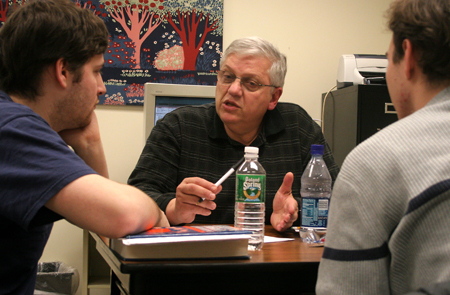
Students enrolled in U.S. Labor Politics, Policy and Law are placed in an unexpected classroom setting where the professor openly encourages criticism of his own arguments.
David Cingranelli, who has taught at Binghamton University for over 30 years, has progressive views on labor laws in the United States. In this class, Cingranelli argues that the standard of living is directly correlated with the government taking responsibility to see its country’s citizens fulfilling their potential.
The government should make workers a priority, as the majority of the population are workers, not employers. America should be more focused on the relationship between business and the employees, tackling labor issues from a “workers’ rights as human rights” perspective, according to Cingranelli.
The class is heavy in reading, but Jessica Macrina, a junior political science major, said that it’s easy to get passionate about the issues Cingranelli presents.
“He really engages students through opening discussion to anyone,” Macrina said.
Cingranelli said he invites criticism of his own arguments, desiring to learn something from his students, and tries to present all sides of the issues discussed in class. One of the textbooks for the class, “Keeping America Competitive,” argues against his own ideas about labor policy. This effort at critical thinking is not lost on his students.
He doesn’t push his ideas on his students as the right way to think, but wants students to come to their own decisions, said Mike Theetge, a sophomore political science major.
“He’s one of the first professors that I’ve encountered that wants you to see all sides of the issues, and encourages students to debate his ideas,” Theetge said.
After teaching the course for seven years, Cingranelli has recently started to focus more on labor in a global economy setting. It is hard to say what an American corporation is, as few companies see themselves as American, said Cingranelli. They are really more global with American headquarters.
Cingranelli presents ideas that undergraduate students might not normally think about, such as vacation time for employees. American workers rarely receive paid vacation, but this is something that is required by law in the European Union after a year of employment with one company.
The class’ topics might not affect students now, but students walk away from Political Science 366 with a good idea of the future workforce, said Cingranelli.
Cingranelli is the author of “Human Rights and Structural Adjustment,” which focuses on how the structure of the programs put into effect by the World Bank and International Monetary Fund have affected respect for human rights in developing countries. He is also a self-proclaimed pessimist and said that he hopes this can be changed by allowing students to argue against his position in class and in essays.