





The nights of Binghamton University have recently seen more than taxis laden with State Streeters and people shamefully walking home. Lately there has been another group spotted on campus wandering without purpose. Except instead of two legs, they sport four.
One reason for the burgeoning deer population may be the fact that students are not good predators.
‘The only natural predators of deer around here are coyotes,’ said Dylan Horvath, the steward of natural areas for BU. ‘All other large predators (pumas, wolves) have been extirpated (killed off/driven out).’
This lack of predation has taken a toll on the local environment, which has reached its carrying capacity for deer.
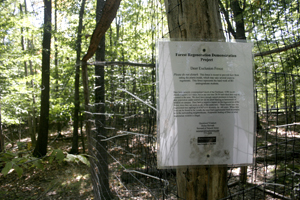
According to Horvath, the 30 acres surrounding College-in-the-Woods should only shelter one or two deer, but often more than 20 can be found in the area. With so many in one area, the food supply has been hard hit.
‘The effect of the deer on the ecology of the forest is truly scary,’ Horvath said. ‘The deer have eaten everything from their head height down to the ground.’
Even with the deer’s effect on the local foliage, a large die-off is not expected.
‘The only real renewable/natural food sources for deer are acorns, fungi, and new growth on trees and shrubs. So in order to survive, they go onto campus or into the surrounding neighborhoods to eat plantings, gardens, etc.,’ Horvath said. ‘The also get some food from mowed lawns where there is always new tender plants growing.’
With large supplemental food resources, very few events would make a dent in the deer population.
‘Large die-offs occur sometimes in deer populations from lack of food in the winter, but I don’t see that happening here unless we get a particularly severe winter at some point,’ Horvath added. ‘The more likely cause of a die-off here would be disease from the unnatural increased density of deer.’
In fact, one of the biggest predators for Binghamton deer may have wheels instead of legs.
‘One was hit on the east access road about a week ago and there was another one on Bunn Hill a few weeks ago,’ said patrolman Doug Bonawitz of Binghamton University Police Department. ‘There was probably another doe hit a while ago. It was seen limping, but no report was filed.’
So many cars coupled with the deer’s lack of fear toward humans on campus has created an animal population that may experience problems if more natural predators appear.
‘There’s at least one study suggesting deer are becoming ‘lazy and short-legged’ without predators to chase them around,’ Horvath explained. ‘In other words, in some areas deer may be devolving into less-agile and less-alert animals.’
While the risk of hitting a deer is small, it is still a possibility.
‘Everyone just has to be aware that they’re out there,’ Bonawitz said. ‘They just need to slow down and be more observant.’