





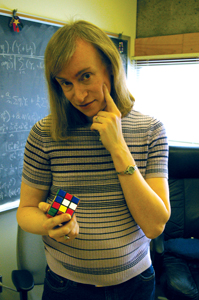
Solving a Rubik’s Cube is no easy task, but a Binghamton University professor is world-renowned for her method of cracking the puzzle in record time.
Speedcubing, a craze that has gained significant popularity in recent years, is a competitive activity aimed at completing a Rubik’s Cube in the fastest time possible.
Jessica Fridrich, a professor of electrical and computer engineering at BU, created the “Fridrich Method” of speedcubing, which is used by some of the world’s fastest participants.
Fridrich took two years to complete the method and was assisted by Miroslav Goljan, who is currently a research scientist at the University.
In 2005, Goljan traveled to San Francisco and formed a new world record by managing to solve a cube in 28 total moves.
“They only gave us one hour to work everything out, and provided us with pens, paper and stickers to place on parts of the cube for experimentation,” Goljan said.
Goljan’s record would last for three years — the longest standing record in Rubik’s Cube history, before it was bested by the Netherlands’ Guus Razoux Schultz by one fewer move in 2008.
Fridrich’s method of completing the puzzle first focuses on solving the bottom two layers of the cube using a cross pattern. Once those layers are solved, the next step involves re-arranging the cube so the yellow side is on the top, and then finally using additional moves to redistribute the other colors to their appropriate sides.
The Fridrich method can be done by using 53 different algorithms, which are predetermined sets of moves to arrange different parts of the puzzle in a certain manner.
Fridrich’s first glimpse of a Rubik’s Cube was in 1981 at her high school, and Fridrich said she became interested in the puzzle because the solution was simple to explain, but difficult to achieve.
Before she received her first Rubik’s Cube, Fridrich started composing her method using a pen and notebook. Goljan said that most methods for solving the Rubik’s Cube today are derived from computer programs, but the Fridrich method was created in the early 1980s before computers were as widespread.
“We spent many nights thinking of anything that could be useful for the method,” Goljan said.
Fridrich was involved with an Internet listserv called “Cube Lovers” in 1997, and was convinced to put her findings on a Web site by member Mike Bugh.
“At first I didn’t even put a hit-counter on the Web page, because I had no idea how popular it would become,” Fridrich said.
Around the year 2000 Fridrich began to receive e-mails from people who were discussing her method on the Internet with other Cube enthusiasts. Today there are hundreds of YouTube videos online that demonstrate the Fridrich method.
Dan Knights, a former world champion of speedcubing, came to BU in 1999 to receive expert instruction and advice from Fridrich on her style.
“I could tell right away that he was going to be very talented and fast,” Fridrich said.
The pair went to the World Rubik’s Cube Championship in Toronto in 2003 and competed in a tournament to solve the Cube the quickest.
Knights won the competition with an average solving time of 20 seconds, with Fridrich coming in second place with 20.48 seconds.
Goljan also achieved notable success solving the cube, but in a different style — with the fewest moves possible.