





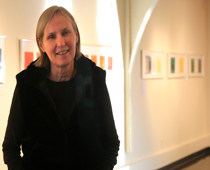
The clash of colors that characterize human vision, as explored by famed abstract artist Josef Albers, is the subject of a new exhibit at the Binghamton University Art Museum. Curator Lynn Gamwell will be giving two lectures during the exhibit’s month-long stay to elucidate the ties between Albers’ artwork and modern science.
Though to some his work may initially seem simple, Albers’ overlapping boxes of colors and shades became the foundation of color theory, which is still regularly taught in art classes.
“This is the science of color, it’s about physiology,” Gamwell, who holds a Ph. D in art history from UCLA, said. “It’s about art, but it’s also about vision — about how you see.”
Albers’ lithographs are printed onto small rectangular sheets of paper. In most, a few colors mingle and seem to change hue to the viewer depending on what other colors are nearby.
“If you put a green color in a blue environment, is that going to make it look more blue or more yellow?” Gamwell asked. “The yellow will come out more.”
“Exploring the Invisible,” a book by Gamwell published in 2002, examines the convergence of modern science and art. Abstract art, she explained, originates in higher sciences — where pattern recognition and analysis take priority over preconceived meanings.
To Gamwell, beauty can be found in art such as Albers’ even if there is no concrete meaning.
“It’s meaning-free,” she said. “We don’t want to call it meaningless, that’s a pejorative, that’s negative — it’s meaning free. But we can give it meaning.”
She relates abstract art to Darwin’s theory of evolution, in that although both imply a lack of ultimate meaning, both also reveal a world of complexity and beauty.
Gamwell will be exploring these issues, with particular focus on Albers’ art, in two lectures during the next month. The first, on Feb. 27, will be at noon in the Art Gallery in Fine Arts Building, room 213. The topic will be “Albers and the Symmetry of Nature.” The second talk, at noon on March 19, will also be in the gallery and will examine “Albers and Color Theory.”
The museum welcomes students who are interested in learning more about this topic to visit. Tours are offered Tuesday through Saturday during regular hours, which are noon to 4 p.m., or by appointment. A documentary on Albers is also available for viewing. There is no charge for admission.
According to Silvia Ivanova, the museum registrar, some BU community members may not be aware of how vast a collection is housed in a vault beneath the Fine Arts Building.
“We own more than 3,000 original works of art,” she said. “They’re part of our permanent collection.”
In addition, the museum is also the host of various traveling exhibits, such as the Albers collection.
The museum’s holdings range from Ancient Greek pottery, to animal statuettes from China’s Tang dynasty, to Egyptian sculpture from the time of Tutankhamen.
“We have a global collection of art history, so we think of it as the ‘mini-Met,’” joked Gamwell, “because it’s a little bit of everything.”