





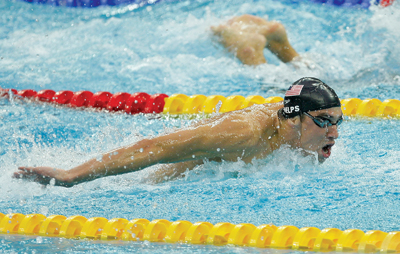
If there are two words that could sum up the 2008 Summer Olympic Games, they would be “Michael Phelps.”
The 23-year-old swimmer from Baltimore, Md., lit up the Water Cube, Beijing’s National Aquatics Center, home to the swimming events of games.
At 6 feet 4 inches and 200 pounds, Phelps won eight gold medals and set seven world records in Beijing.
Many elements were key to Phelps’ historical feats this summer, including his prior experience, training, a new suit and some luck. Binghamton University’s swimming and diving head coach, Sean Clark, gave insight about all those factors that helped Phelps achieve such accomplishments.
Clark first noted Phelps’ age. Phelps competed in his first Olympics in the 2000 Summer Games in Sydney at age 15.
“He is obviously talented beyond his years,” Clark said.
Phelps became the youngest male swimmer to represent America at the Olympic Games in 68 years. Though Phelps did not leave with a medal at the Sydney games, he finished fifth in the 200-meter butterfly, showing the world he had what it takes.
Only months after becoming one of the youngest Olympic athletes ever, Phelps stunned the world again, becoming the youngest man to set a swimming world record, swimming the 200-meter butterfly.
Four years later, Phelps returned to the national stage in Athens, taking home six gold medals and two bronze. He set two world records, three Olympic records and two American records.
But it’s the events that unfolded during the 2008 Olympics in Beijing that has everyone talking.
Phelps won all eight events he competed in, claiming eight gold medals, breaking the world record for most gold medals at a single Olympics, a record previously held by American swimmer Mark Spitz. Phelps also set seven world records.
It was Phelps’ dedication that solidified his name in Olympic history, according to Clark.
“His possible drive put him in this position. He was so close in 2004 when he went 6-for-8,” Clark said. “His lung capacity is legendary.”
A Historic Moment
One of the most talked-about moments of this Olympics was the photographic finish of the men’s 100-meter butterfly.
Going for his seventh gold medal, Phelps faced a challenging race against Serbian-American Milorad Cavic.
Cavic led the race all the way up to the final stroke, when it seemed as if Phelps had finally been defeated.
As Cavic took his last stroke and began to glide to a finish, Phelps misjudged the wall and took another stroke, placing him an arm length behind Cavic, causing everyone to believe Phelps had lost.
It was not until the official times came on the board that everyone, including Phelps and Cavic, realized Phelps had beat Cavic by .01 seconds, with a time of 50.58 seconds to Cavic’s 50.59.
Clark offered a reason for Phelps fingernail finish.
“He did what he needed to do when he needed to do it,” Clark said. “That’s why he is Michael Phelps.”
According to Clark, Cavic picked his head up instead of keeping it down and pushing his momentum forward to the wall.
“Milorad Cavic would have been an Olympics champion and a legend,” he said. “But he made a mistake.”
Phelps was not the only one who set world records during the games. A total of 25 world records were set in 21 events, some records being set in some events’ preliminaries and then set again in the finals.
But one question remains. With all these records being set, will a time come when records will be unbreakable?
“We’ve always said, ‘This person swam an amazing race,’ but it can be broken,” Clark said. “Phelps was pushed [in the 100m butterfly]. His world records will be broken.”
The coach, however, also said that the world won’t see a similar athlete come along in the sport.
“We won’t see the whole package,” Clark said. “But one at a time, his records will be broken.”
The Masterpiece by Speedo
Phelps owes thanks to Speedo for their new product, the LZR Racer, a state-of-the-art swim suit. Since the suits’ introduction to the swimming community last February, 62 world records have been broken.
The suit, designed by NASA, was built to compress the muscles, holding them in line to do what they need to do. The suit is layered with polyurethane and the seams are laser-welded, allowing water to flow over the body smoothly and reducing drag in the water.
The NCAA wants to ban the suit from competition because of the unfair advantage it would bring to the college level.
The suit cost $450, a price Clark said many schools and students cannot afford. Allowing students who could afford the suits to wear it in competition is an unfair advantage over previous suits.
Clark said he is personally for the ban.
“It is artificial advantage. Yet everyone who wore it loves it. It makes you feel fast,” Clark said. “But if everyone has it, it is not an advantage.”
The suit has been reported to lower race times between 1.9 and 2.2 percent.
Phelps’ time for the 100-meter butterfly before the Olympics was 51.10 seconds, but in Beijing he swam 50.58, cutting his time by .52 seconds. Clark said he is not sure if it was the suit or the training that helped Phelps and other swimmers lower their times.
“There’s not enough information and testing to tell for sure,” Clark said. “But for a Binghamton swimmer, the suit might cut a half second to a full second per 100 meters.”
Phelps vs. Binghamton
Clark praised his swimmers as conference finalist and champions, but he pointed out how fast Phelps swims, comparing him to Division I Binghamton University swimmers.
“Phelps swims the 200-meter individual medley about 18 seconds faster than Brenno Varanda, Binghamton’s best 200 IM swimmer,” Clark said. “That is a full pool length.”
Phelps also swims the 100-meter butterfly about 8 seconds faster and the 200-meter freestyle about 11 seconds faster than Binghamton’s greats.
“Don’t get me wrong, Binghamton has great swimmers,” Clark said.
Though Binghamton swimmers might not be able to swim at the level of Phelps, Clark only hopes that his athletes be the best they can.
“At the D1 level, our goal is to achieve our ultimate capabilities, and when we see others pass their limits, we have to rethink our own limits,” Clark said. “It’s inspiring and makes you want to work hard every day. The whole swimming community is energized now by the ‘08 Olympics.”
The Breakfast of Champs
When it comes to Phelps’ training and eating regimens, including a 12,000-calorie-a-day diet and a minimum of 30 hours of training per week, Clark said just six words.
“You have to feed the machine,” Clark said.
Clark’s assistant coach, former Binghamton University All-American and Olympian, Yun Qu agreed with Clark, adding that although Phelps might be an individual swimmer in most races, he couldn’t have done it alone.
“It was a team effort, everyone that helped him; from the coaches, teammates, even his mom,” Qu said.
Qu, who swam for her native country of China in the 1996 Summer Olympics in Atlanta, finished fourth in the women’s 200-meter butterfly.
The former Olympian knew exactly the kind of training it took to make it to the big stage.
“The focus level is very important for a sport like swimming,” Qu said. “Phelps didn’t miss any practice. He trained harder and smarter and pushed everyday.”
But don’t expect any Binghamton swimmers to be wolfing down that much food and training like that. NCAA has rules as to how many hours college swimmers can train: 20 hours a week officially through the school. Athletes can do more if they want, but coaches cannot make it a requirement.
“At Binghamton, our swimmers are hard pressed; in the pool, the classroom, and they still have to have a social life,” Clark said. “Last spring we had 37 swimmers with GPAs above a 3.0.”
Though the Olympics just ended, Clark is excited to watch Phelps in the near future and the 2012 Olympics in London.
“He will not swim as many races, though, like 400 IM, which he won’t swim again,” Clark said. “It’s a grueling race; he said he is done with it.”
As far as the prospects of Phelps going for nine gold medals in 2012, Clark only hopes Phelps has fun doing it.
“He has earned the right to enjoy the sport without any expectations.”
With all the advancements in the sport, Clark questioned how much the human body could be pushed.
“I don’t know what the limits of humanity are, but it is fun to push those limits ” Clark said. “Every year there will be an eye-opening experience.”