





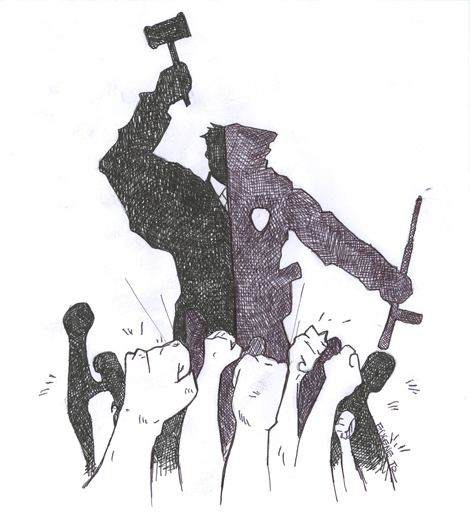
In the weeks following the March 18 anti-war protest on Vestal Parkway, the rally began to stand for more than just the fifth anniversary of the war in Iraq.
Professors and graduate students took up the cause and supported the protesters — rightly or wrongly — as emblems of free speech, student power and the return of collegiate activism. But while the nine protesters (eight of them students) faced the law of Broome County, the University’s judicial board was mounting its case against them as well.
Finally, an agreement Thursday reversed a nonsensical decision to prosecute the protesters on campus (see page 1) — a decision that never should have had to be made in the first place.
When Binghamton University decides to charge students who are already facing possible punishment from a legitimate legal body, they are putting themselves above the law, and in turn creating a dangerous scenario of double jeopardy for students who are charged with breaking the law off campus.
It’s certainly not the case that justice has a quota on campus, but by mounting accusations on the student protesters administrators definitely made it seem like it does.
Now it is for Vestal Town Court to determine whether the protesters broke the law during a confrontation with police as they turned off Vestal Parkway and into University Plaza toward the recruitment center.
Although students — including those who break the law off campus — are representatives of the University, that shouldn’t equate to judicial punishment in every case, and particularly not this one. Theirs wasn’t even a violent crime, and the high-profile case has received significant coverage from the local press.
It is unfortunate that the rally ended in a confrontation between police and protesters, and regrettable that the University ever tacked on additional charges to students already facing legal proceedings. But from this memorable chapter in BU’s history, one gleaming facet is the cooperation between administrators, students and faculty to reach a sensible decision on the judicial issue on campus; faculty wrote expressions of their support to this publication and to other bodies on campus, and the Graduate Student Organization backed the protesters in a meeting with Brian T. Rose, the vice president for Student Affairs.
The remarkably positive result of cooperation between disparate groups who would not normally work together seems to have crawled out of this mess of grievances and judicial proceedings. If nothing else, it served as training wheels for Vice President Rose, an administrator who — like his predecessor Rodger Summers — will undoubtedly have to work as a mediator several more times during his career at BU.