





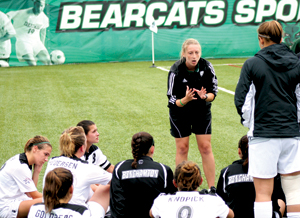
She watched from the sideline, she played the game.
Now Sarah McClellan is back on the sideline, this time as Binghamton University’s women’s head soccer coach.
McClellan traces the dirt on her cleats back to her childhood in Maryland, to a time when she always wanted to do what her older siblings did.
She first mimicked her sister by attempting gymnastics, but quit after a month.
“I hated it. Plus, I was really bad at it,” McClellan said.
So as a fast and athletic five- to six-year-old, McClellan set her eyes on the sport her brother played: soccer.
Something clicked.
When she was eight and nine, McClellan played for a female coach who would always pull her aside before a game and ask what position she wanted to play, which McClellan said was left wing, up top as an attacker.
“She recognized that I was very good,” McClellan said.
This coach helped McClellan develop a passion for soccer.
“For every player that plays this sport and really loves it, there is a time in their life that everything is just like, ‘This is it, soccer is it for me,’” McClellan said.
McClellan said she’d ask some of her players when they knew soccer was for them.
“They would have to think about it, but there is a time and they would come back to me the next day and say, ‘It was … ,’” she said.
For McClellan — one moment, one game — soccer clicked when, at eight years old, she played for that coach. McClellan vividly remembers that moment.
While playing left wing, she watched as the ball was played to the right side of the field.
Thoughts raced through her mind.
“It’s out of my position. Do I go for it and hope that no one gets mad at me?” McClellan remembered asking herself.
She made that tough decision and ran clear across the field, knowing she was going to get there first. She dribbled past the defenders, dribbled past the goalkeeper and sent the ball to the back of the net.
“I didn’t celebrate,” McClellan said with a hint of laughter. “I was a little bit nervous about what everyone was going to say.”
But there was uproar in the crowd.
“I was like, ‘Oh, that is awesome. I can do whatever I want, make my own decisions and it’s OK when I am on the field.’”
YEARS PASSED
McClellan, as a senior in high school, had played travel premier soccer for several years. She grew up with teammates she played with on the same club team since she was 12. They played at the highest level of competition for their age, but to them, they were just having fun.
Now McClellan wanted to play college soccer.
“[The problem was that] I never really knew the process of going to college. So I was just walking around blind as far as playing for college,” she said.
McClellan’s finesse with the ball on her premier club team caught the eye of several Division I schools, including Towson, UMBC and Maryland. But Bridgewater College, a Division III school, offered her an academic full ride in 1999, and their persistence convinced her.
“[Bridgewater’s] coach called me once every week for about four or five months,” she said.
But McClellan’s tenure at Bridgewater was short. They could no longer offer her what she wanted.
“As much as the girls were fun to play with, I thought I was just wasting my time if I was just playing soccer and wasn’t getting better.”
She felt the need to move on.
McClellan reconnected with Maryland’s coaching staff, including head coach Shannon Higgins-Cirovski, who had recruited McClellan when she was in high school.
“I asked if they had a spot for me, if I could come to preseason and let me play at the highest level possible,” she said.
McClellan knew Maryland would be no walk in the park, but she didn’t care.
It was exactly what she wanted.
She told Shannon that she wasn’t going to be satisfied with sitting on the bench; she wanted to be challenged every day to be able to play at the Division I level.
That was the way Shannon operated.
“She never wanted you to be satisfied, and if you were satisfied, you were probably going to be benched the next day,” McClellan said. “My kind of mentality worked right into her philosophy.”
Three of the most competitive years of McClellan’s life had passed.
Maryland was in the top 25 in the nation. But there were downsides, too. McClellan suffered from chronic injuries — ankle tendinitis and shin splints — and was restricted to a walking boot during her senior year.
“I wore [the boot] around campus, my house, to practice, to the locker room, to the field, and when I got to the field, I could exchange my boot for my cleats and play,” she said.
Although she wasn’t in top condition, she pushed through practices because the Terps needed the help.
Growing up in a generation that watched Mia Hamm, the face of women’s soccer, McClellan never thought she would get to that level. But one spring, the Terps hosted a WUSA team and McClellan played against Hamm.
“I actually marked her, which was really cool,” McClellan said.
At every home game for Maryland, a man named Pat Noel waited at the edge of the track to talk to McClellan.
Noel, a director of a local soccer club, wanted her to coach a youth soccer team after she graduated. Every time McClellan declined the offer. But after her last career game, which Maryland lost, McClellan described the moment as a surreal experience.
“All of a sudden it is over and all the seniors walked off the field, kind of misguided as to what we do now,” she said.
WHAT TO DO NOW?
A week later, Noel convinced McClellan. The team of 12-year-old “misfits” taught her a lot of patience, McClellan said.
“I had to lower my intensity level to their level.”
After that season, McClellan realized she was not cut out to coach young kids. McClellan said her intensity and harshness work well with older teams.
“[My players] know right away when I think they aren’t playing well. These players understand that me being brutally honest with them as players is me respecting them as players. Obviously, 11- to 12-year-olds can’t understand that and just cry.”
At the same time, McClellan said she is the first to praise players when they do well, even celebrating on the sideline.
“My players look at me and are like, ‘It was just a pass,’ and I am like, ‘Yeah, but it was a really good one,’” she said.
McClellan played semi-professional ball in the W-League. She also played for the Maryland Pride, a pre-professional team in the Women’s Premier Soccer League.
McClellan got her college coaching feet wet in 2003 when she became an assistant coach at Goucher College. They had the second largest turnaround in the nation, going 0-16-2 in 2002 and 8-7-4 in 2003. She wanted to pursue coaching, even though, as a biochemistry major, she was ready to put on a lab coat all day, every day, because she enjoyed it.
“Soccer kind of stopped that plan, in a good way,” McClellan said. “I felt that [coaching] was my calling, but I was still hesitant to basically throw away my biochemistry degree.”
After her stint at Goucher, McClellan coached at Drury University for two years, got a master’s degree in education and then coached her former WPSL team. From there McClellan came to Binghamton, where she was an assistant coach for two years before being named head coach in February.
A COACH TO LEARN FROM
McClellan thanked Shannon, who she called the single most important part of her career, for her coaching abilities. McClellan said she absorbed everything her coach taught her during those three years.
“She is the smartest tactical coach I have ever met, including coaches I meet now as a coach. Shannon made me really want to push myself by asking me to do better,” she said. “I didn’t know it at the time, but she prepared me to be a coach while I struggled with injuries. Everything she taught me, I was able to apply afterward and now as a coach.”
This may explain her ability to empathize with Binghamton senior captain Kelly Haslinger, who is currently injured.
“She has been supportive of that, helping me get through things, and she treats every player like that,” Haslinger said.
McClellan has been trying to inspire the team, Haslinger said, and has done so by setting team goals and starting preseason off the right way.
“It is something that is ingrained in every athlete, to want to be successful, and hopefully a coach can bring that out,” Haslinger said.
McClellan knows what it’s like to be sidelined. She’s been there.
But, she said, “A reserve player is just as important as any other player, and they have to do their best for the team.”
Though players might not be satisfied with their position on a team, it is a reality they have to deal with because they still have a role to play on the team, McClellan said. But she also relates to other types of players.
“Having played for WPSL, I understand what it’s like to be the captain and the leader of the team.”
Throughout her life, McClellan’s parents watched from the sideline as their daughter chased after the ball. Their role in her soccer career is one McClellan hopes more parents will follow.
“Parents see their kids are going to be good players, push their kids, and the kids end up burning out,” she said. “I never burned out because it would have been perfectly fine with my parents if I said I never wanted to play soccer anymore. They were supportive, but they didn’t push me, they didn’t pressure me.”
McClellan said her parents aren’t that overly interested in soccer and weren’t ecstatic when she said she wanted to go into coaching instead of biochemistry.
“But they saw me coach and were won over by how passionate I am. Now they just think I’m the best coach ever, but they still don’t know much about soccer,” McClellan said, laughing. “Does that make my parents sound really bad?”
BIOCHEMISTRY MEETS SOCCER
McClellan, who is known for her recruiting practices, said she looks for athletic, fast, smart, hard-working players that have an attitude about them on the field.
“Not a bad attitude, but a very confident-competitive attitude, competitive being that hard-working part and confident being the technical, savvy player that they are,” McClellan said. “On top of that, and just as important, they have to be coachable.”
McClellan looks for perfection from her players, a trait she believes she received from the biochemistry concentration.
Freshman midfielder Taylor Kucharski said McClellan’s experience as a player and coach are why she wanted to play for her.
“She knows what she is doing; she knows our perspective of it. She knows what we want and how everything should be run,” Kucharski said. “Her mentality is really into hard work, and that pays off.”
Binghamton assistant coach Matt Dunn praised McClellan’s recruiting abilities.
“She is incredibly thorough. The caliber of our 2009 class coming in is a testament to her work ethic,” Dunn said. “She put a ton of time in there on her own, before Elke [Reisdorph] and I were hired [as assistant coaches].”
Dunn was quick to accept the job to work alongside McClellan.
“I loved the fact that it was virtually a new program, just working to change for the better, and that was incredibly appealing for me,” he said.
From the beginning, Dunn noticed McClellan’s fierce intensity when preparing the team to be the best they can be.
“She, Elke and I have so many similar philosophies and opinions. We share a steely intensity when it comes to soccer,” Dunn said. “We just work exceptionally well together, and it is a pleasure coming into work every day.”
Dunn summed McClellan up in one word: winner.
But Haslinger had other thoughts. “I don’t think you can really sum her up in one word,” she said.