





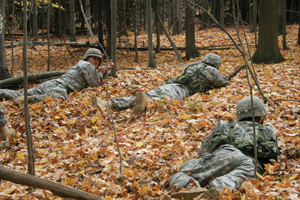
For students interested in attending college and serving their country at the same time, the Reserve Officers’ Training Corps (ROTC) offers the ideal program.
According to student publication Cornell Moderator, Binghamton University’s ROTC branch, a detachment of Cornell University’s chapter, was established in 1990 when cadets first began commuting to Cornell University for classes and military training.
Since then the detachment has increased its presence at BU, offering classes at both Binghamton and Cornell.
Major Don Johnson, head of the program at Binghamton, said he believed that existing efforts to expand will one day result in the branch having the ability to support a “full staff on Binghamton University” for the convenience of student cadets.
Binghamton’s ROTC recruitment rate has been showing mostly consistent, and sometimes rising, numbers annually, according to Johnson.
There are 12 cadets in ROTC, a two-fold increase from last semester. In May 2008, four members were commissioned, he said. Out of the 12, two are females, both of whom are sophomores.
Jonathan Pettit, a senior political science major and cadet captain, said he is not surprised by the rising recruiting numbers.
“People want to serve their country, do their duty, things like that … It’s different from enlisting because you still can get a college degree and college experience,” he said.
For the first two years in the ROTC, there is no binding commitment to serve the army. In the third year, continuing cadets can decide whether or not to commit to four years of service in Active Duty, the National Guard or the Reserve.
Binghamton’s ROTC program entails physical training, military science class and leadership lab.
Otherwise known as “PT,” physical training takes place at the East Gym from 6:30 to 7:30 a.m. every Monday, Wednesday and Friday. The training prepares members for their upcoming physical examinations, which require cadets ages 17 to 21 to complete a minimum of 42 push-ups in two minutes, 53 sit-ups in two minutes and a two-mile run in less than 16 minutes.
In addition to this, the ROTC requires attendance in both class and lab instruction, which is headed by Cadet Command Sergeant Major Matthew Toal, a news writer for Pipe Dream and senior political science major. During Military Science Year I, members learn about rank structure, military history, land navigation, squad tactics and teamwork.
Military Science Year II is a reinforcement of the topics taught in the first year of the program, and the third course in the series marks the peak for most cadets, with the Leader Development and Assessment Course (LDAC) in the summer. The LDAC is a paid, five-week course conducted at Fort Lewis, Wash.
Pettit believes that the reward in participating in ROTC is the leadership, discipline and time-management skills gained from the experience.
“I am amazed at the willingness of college students to serve our country and be involved with something bigger than themselves,” Johnson said. “Even though we are at war, these young Americans are willing to join and lead others.”
Although the war may be seen as a potential deterrent to prospective students, ROTC cadets believe the opposite, according to Johnson.
While peace protesters, students and faculty members may disagree with the intentions of the war, Johnson says they still “respect” ROTC members for defending the country.
“Binghamton has quality students that we train to be quality leaders,” Johnson said. “We want students who are willing to become leaders, serve and represent their country, care for the soldiers entrusted in their charge and accomplish the mission.”