





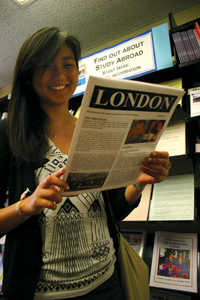
In an international world, studying abroad opens a wide range of possibilities, and some students have used their experiences to forge connections and find employment in other countries.
Through Binghamton University and the SUNY system, BU students are eligible for over 400 different programs worldwide, which an estimated 20 percent of students partake in each year, according to study abroad coordinator Giselda Beaudin.
In light of the Study Abroad Fair to be held Wednesday, Beaudin said she strongly recommended studying abroad and that she thought the benefits were three-fold.
“There are personal, professional and academic benefits,” she said. “When students fill out personal evaluations at the end they generally report that they’ve grown in all three areas, and most find that they are more confident.”
Professionally, studying abroad has many advantages.
“One of the basic ways that studying abroad can help is that when you are speaking in a job interview, it is easy to draw upon the experience,” Beaudin said.
Moreover, there are many opportunities abroad. Some of the most common forms of employment for Americans include teaching English in foreign schools, joining the Peace Corps and working for American companies, Beaudin said.
According to Beaudin, some ways for students to make foreign connections are to get in touch with a company and shadow someone, research with a professor at a foreign university or get involved in volunteering or internship programs.
“You have to think about it to get a career abroad,” Beaudin said. “There are direct benefits for the legwork.”
BU students and alumni can attest to this, having used their study abroad experiences to land jobs.
Carly Robinson, a BU graduate who studied in Avignon, France, said going abroad was on her “radar” during her college search.
“I always knew I wanted to study abroad,” Robinson said. “I really liked studying languages in high school and I was a French major, so it made sense to round out my classroom experience with an experience abroad.”
Robinson recently got a job teaching English in France.
“It is a great opportunity to really get to know the area and be a part of the community,” she said, adding that once the paperwork was complete, she would receive her “carte de sejour,” allowing her access to the social services available to French citizens.
For a student who wants to get involved in a study abroad program, Robinson recommended researching the subject — browsing online, talking to students who’ve gone abroad, speaking with advisers and, most importantly, leaving plenty of time to apply for scholarships.
Angela Zhu, a current BU senior completing a double concentration in marketing and leadership and consulting, said she was offered a job after graduation at the company she interned with while studying abroad in London.
Rather than shadowing people around while interning at the Canary Wharf Group, Zhu said she chose to work on a major project.
“Throughout the whole semester I worked hard to identify celebrity chefs and people from hospitality groups for the advisory group, and contact them and meet with them to discuss their involvement,” Zhu said.
Zhu said she found the experiences of working with professionals, attending meetings and pitching projects to be especially educational.
“This wasn’t like being in class and presenting to a professor,” Zhu said. “I was having an important business meeting with another professional and I knew that if I screwed it up, it’s money lost, not a grade.”
The program had other benefits as well, Zhu said.
“I have built a great network of people in London,” Zhu said. “I made friends with Londoners and when I would hang out with them, I was able to learn about their culture and social scenes. I am still in contact with them and I have people to visit if I go back.”