





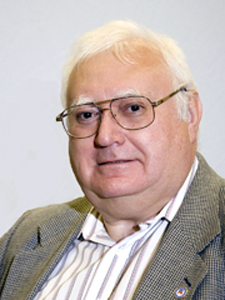
The Binghamton University professor being held overseas on charges of currency smuggling was found guilty Friday and forced to pay a fine.
On his way out of the country on Sept. 29, Victor Skormin, an engineering professor, was stopped by customs authorities and found to be in possession of $14,221 in American currency. According to an online journal he’s kept since his arrival in Kazakhstan on Sept. 12, Skormin had gone abroad to meet with Kazakh professors at different universities, and to recruit students for BU’s graduate school.
Shortly after being detained, Skormin ran out of the medication he used to treat his diabetes and high blood pressure. When his feet began to swell on Oct. 17, he checked himself into a clinic for treatment.
According to Skormin, however, one of the medications he purchased to treat his condition was counterfeit. He was only able to access the proper medication when his son sent it by overnight mail and managed to get it delivered to his attorney in Kazakhstan.
“I feel better than before since I started taking the medication,” Skormin said.
As a result of his conviction, funds exceeding $3,000 were confiscated from him, and Skormin was fined an additional $2,000 and required to pay $1,000 in court fees.
A Web site, BringVictorHome.com, was established last Wednesday by a colleague of Skormin’s in an effort to spread the word about his situation.
The Kazakh judicial system is run on bribes and telephone calls, Skormin said, and if one of the parties is the government, it will always prevail in court.
“I was expected to give a bribe and I didn’t,” he said. “This is how I showed respect for local law.”
In order to allow time for possible appeals by the prosecution and the defense, Skormin said he must remain in the country for 15 days, starting the day after the verdict was reached.
According to Jim Moronski, an adjunct lecturer at BU and close friend of the professor, Skormin is working to shorten the 15-day period and accelerate his return home.
“Since the verdict did not go in his favor and the fines and penalties are a sum of money they’ve already confiscated, he believes it may be possible to come home sooner,” he said.
Skormin said that because of Republic Day, a national holiday in Kazakhstan, nothing had been done on his case for the past three days. However, he said he planned to talk to his lawyer today to try to convince the court that it was “meaningless to wait 15 days.”
Moronski said that he and other friends are hoping for Skormin’s return as soon as Thursday, but that it most likely wouldn’t be for a couple of weeks.
According to BU spokeswoman Gail Glover, while Skormin’s legal strategy is between the professor and his lawyer, the University will continue to provide appropriate support as requested.
“We are in regular contact with the U.S. Embassy and have had conversations with our federal representatives, who have also connected with the U.S. Embassy in Kazakstan,” she said. “We are currently awaiting news from the U.S. Embassy as to whether the appeals period will be shortened by the judge.”
“It is our understanding from our contact with the U.S. Embassy that this decision will be made early this week,” she added.
Glover also said that members of the administration have spoken to Skormin several times, and have kept in daily contact with his son. They also sent two letters of support, though the court refused to take them into account, Skormin said.
According to Moronski, however, “it appears that they [the administration] did nothing.”
“To get a corrupt system to work non-corruptly, you need attention,” he said, referring to the judicial system in the country Skormin’s being detained.
Moronski added that as far as he knew, the administration had not been in contact with Skormin’s lawyer.
What’s happening still feels like a dream, according to Skormin.
“I am waiting to open my eyes and wake up and be where I am supposed to be — at home,” he said.
People criticize America because they don’t understand how bad the rest of the world is, Skormin said.
“America the beautiful — love it or leave it,” he added.
Skormin, who is “really looking forward to returning home,” said he is very thankful for the many friends he has in Kazakhstan. Two local publications have printed letters on his behalf, as have three major universities and local students, among others.
Upon his return to the United States, Skormin said he plans to thank his friends for being so supportive. He also intends to give talks that will educate people on what’s happening abroad in order to ensure that similar things won’t happen in the United States.
“It’s up to people,” he said.