





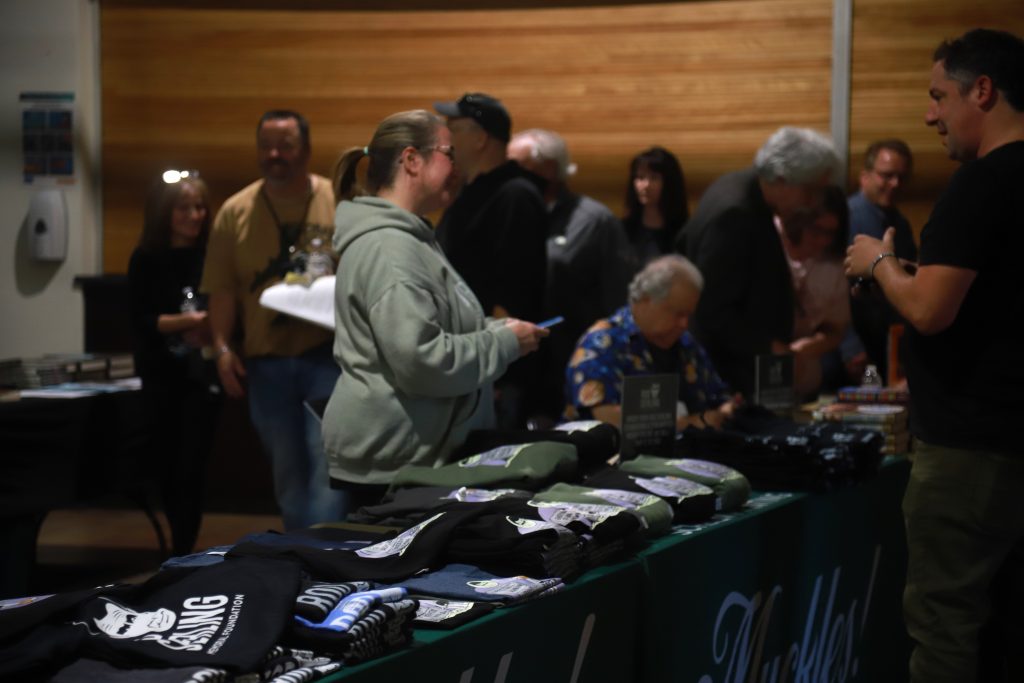
The Rod Serling Memorial Foundation celebrated the life and work of Rod Serling, creator of “The Twilight Zone,” last weekend at the Forum Theatre. Marking 50 years since his passing in 1975, the annual SerlingFest was themed “In His Own Words” and featured screenings of television shows, rare interviews and speeches by the beloved screenwriter and producer who called Binghamton home.
The event spanned three days and spotlighted diverse aspects of Serling’s life and career through a variety of presentations. Mark Olshaker, an Emmy-winning documentary filmmaker, author, foundation member and close friend of Serling, discussed this year’s theme and the writer’s relevance to the current state of the world.
“We’ve tried to come back to as many of his speeches, pronouncements, writings as we could to sort of tell what he was thinking and what his ethos was, what his morality and his view of the world was,” Olshaker said. “And I think in today’s political climate, socioeconomic climate, what’s going on, it’s very important to do. It’s very relevant and I think Rod has a tremendous amount to say to all of us, 50 years after he died.”
“The Twilight Zone” was at the forefront of the festival, with various discussions around the show and vendors selling merch. The first day of SerlingFest 2025 featured several screenings, including an episode from “The Twilight Zone” titled “On Thursday We Leave For Home,” presented by television writer and author Joseph Dougherty, which explored themes of leadership and the difficulty of relinquishing power.
Serling, a six-time Emmy Award-winning writer, was celebrated not only for his famous series but also for his activism and fight for social justice, both on and off the screen. According to the foundation’s website, he was known as “the ’angry young man’ of Hollywood, clashing with television executives and sponsors over a wide range of issues including censorship, racism, and war.” The second day of SerlingFest showcased a heavier emphasis on politics and current issues from the audience engaging in the many Q&A’s and discussions.
“In ‘The Twilight Zone,’ Rod wrote about the human condition and the issues that he was passionate about — prejudice, scapegoating, mob mentality, individual morality — and we continue to deal with these issues 60 years after the series broadcast its final episode,” Nicholas Parisi, the president of the Rod Serling Memorial Foundation, wrote in an email.
Presenters discussed recent creative works inspired by Serling and his voice outside of “The Twilight Zone,” like Ariana Grande’s song “twilight zone,” psychological thriller television series “Severance” and the horror film “Sinners.” Frank Spotnitz, a writer and producer for “The X-Files,” introduced key episodes from the science fiction series that took inspiration from Serling.
Staying true to SerlingFest 2025’s theme, Olshaker presented a rare speech given by Serling at the Library of Congress that addressed the responsibilities of a writer and the importance of free speech.
“In these days, when so many of our rights are being challenged, when the administration and all of its functionaries are trying to stifle dissent, trying to take people off the airwaves who don’t agree with them, I think this is so important, that writing, which was so important to Rod, is the one element that can preserve all of our other freedoms,” Olshaker said. “And when writing is challenged, when it’s stifled, that’s when we have to worry about all of our other freedoms.”
Anne Serling, one of Serling’s daughters and author of “As I Knew Him: My Dad, Rod Serling,” commented on the speech during her panel presentation and reading on the second day of the festival.
“Writing was what my father believed in, what he was passionate about, what he thought had a chance to save society,” Serling said. “In 1968, when the country was in the midst of the divisiveness and turmoil of the civil rights and anti-war movements, it would tear him apart.”
“My dad penned his speech at the Library of Congress in Washington by saying, ‘So long as men write what they want, then all of the other freedoms — all of them — will remain intact,’” she continued. “‘And it is then that writing becomes an act of conscience, a weapon of truth, an article of faith.’”
Anne emphasized the continued impact of her father’s writing by discussing the “Fifth Dimension” curriculum at Binghamton schools that teaches fifth graders about Serling’s messages through “The Twilight Zone” episodes like “Eye of the Beholder” and “The Monsters Are Due on Maple Street.”
Several other presenters brought unique insights about Rod Serling’s impact and influence throughout the event. David Bianculli, a TV critic, columnist, radio personality and professor at Rowan University, discussed teaching Rod Serling’s work to college students and the growing popularity of “The Twilight Zone” among younger generations. He shared his appreciation for Binghamton’s annual SerlingFest.
“For Binghamton and where he comes from, I think this is a great thing,” Bianculli said. “No matter what else I do, I consider myself a writer, and a town that is celebrating a writer — that’s a good town. There aren’t many towns in America that bother to do that.”
Mark Dawidziak, an American author and critic from Cuyahoga Falls, Ohio, discussed Serling’s impact on his home state from his time as a student at Antioch College and upcoming plans to honor Serling’s legacy with a historical marker on Antioch’s campus.
While day two of SerlingFest primarily featured insightful presentations at the Forum Theatre, the last day of the festival was held at Recreation Park, located a few blocks away from Serling’s childhood home. Foundation members read excerpts from speeches by Serling, which was followed by a “The Twilight Zone” trivia led by Parisi.
To end the festivities, Mr Denton on Doomsday, a band with metal and funk influences based in Lansing, Michigan named after a “The Twilight Zone” episode, performed under the Recreation Park pavilion. The band performed its own music, along with a cover of “Twilight Zone” by Golden Earring with Parisi on vocals.
“I hope that our attendees left with a sense that Rod Serling was a man who used his gifts as a storyteller to explore issues that were important to him,” Parisi wrote. “Joe Dougherty talked about how Rod Serling wrote with a ‘sense of urgency,’ as if Rod were always telling the viewer that if they watched a particular show, they were going to hear something that Rod believed was important and vital and urgent for them to hear. I hope that our attendees came away with an even greater sense of Rod Serling’s passions and how he was able to address them in his work.”