





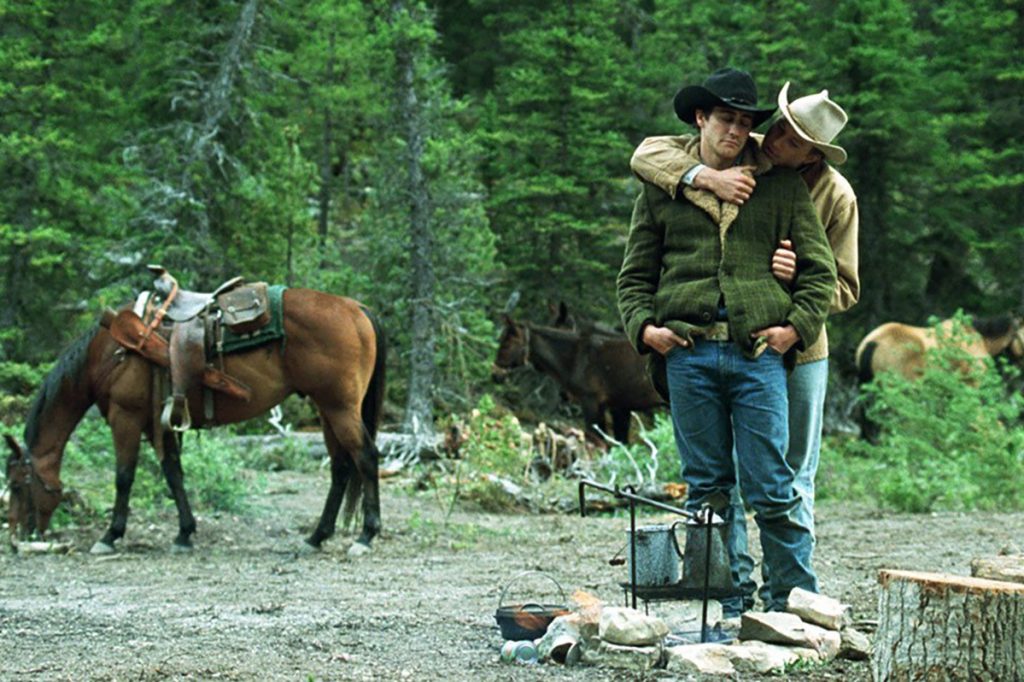
The definition of metamorphose is to undergo a complete, often abrupt or magical, transformation in form or appearance. That is what these films do to our traditional notions of masculinity. One frame at a time, and one line at a time, these movies are among a list of many others that help break the barrier of toxic masculinity in our culture.
“Brokeback Mountain”
This is indeed a movie, as you may already know, about queer cowboys. At its core, however, it involves a lot more. This movie exudes vulnerability and self-expression in its rawest form. Based on Annie Proulx’s book, the story revolves around the lives of two sheep herders played by Jake Gyllenhaal and the late Heath Ledger. They initially meet while being assigned to work together herding sheep in the sunny, surreal mountains of Wyoming and an inexorable romance unfolds.
As time goes on, both men find themselves married with families. But their love for each other does not rest. They each have to grapple with the traditional notions of what a western man in the 1960s ought to be, heteronormative and reserved, versus how they aspire to be — vulnerable and transparent. Whenever they meet in the mountains throughout the film, each character emanates a sense of freedom and attunement to themselves — both in each other’s company and the mesmerizing mountains and the radiant rivers of the landscape. It’s a film that brings pause, questioning the viewer to ask themselves — “Am I living the life others want me to live, or the life I want to live?”
“Boyz n the Hood”
“Boyz n the Hood” is a coming-of-age story centering around Tre Styles, played by Cuba Gooding Jr., as he moves in with his caring father, Jason “Furious” Styles Jr. played by Laurence Fishburne, in South Central Los Angeles. Embracing his new lifestyle, Tre has to navigate the realities of a crime-infested neighborhood. However, Tre has a superpower — a natural and compelling sense of warmth and courage that grounds him.
This film poignantly displays the pivotal role that fathers play in showing their sons not only how to be successful in life, but also how to be a good man. Furious is that father, the wise man who is always by Tre’s corner of the ring. He’s there to tell him the advice he does not want to hear, but needs to as a man growing up amid the shootings and drug dealings of South Central. Furious provides hope that intellect and character will defeat toxic masculinity and violence, and instills these values to Tre.
While this film instills some messages of hope, it does not shy away from a certain sense of dread and inequality that’s important for the world to see.
“Magazine Dreams”
“Magazine Dreams” is a film that can be hard to watch for its extremely grim tone. The protagonist Killian Maddox, played by Jonathan Majors, is lonely and obsessed with one thing, and one thing only — bodybuilding. His only priority is to sculpt his body to be the finest piece of art it can be, everything needs to be perfectly placed and in proportion. The striated lines of his forearms, or the size of a delt in one shoulder, all need to lie in cultivated congruence.
Killian lacks any kind of social relationship with other human beings and channels all of his unapproachable desires into this one element of his life, giving insight into the psyche and mental framework of a man with an obsession. It’s a cautionary tale, in the sense that it highlights the importance of building strong and loving relationships with others.
The movie also brings up an important theme of masculinity and its association with the body. Conventionally, a masculine man is envisioned with large biceps and quads. While these are certainly not attributes to shy away from, “Magazine Dreams” points out the absurdity of this being the norm for what we consider to be the core attributes of masculinity. Shifting the dialogue from bulging biceps as being the defining feature of a man, to the ideal man being someone capable of forming a healthy relationship with himself and the world around him.
“Boyhood”
Director Richard Linklater melds the barrier between the screen and reality in this thought-provoking film. This movie took an astonishing twelve years to make, following one single boy named Mason, played by Ellar Coltrane, starting at six years old until his first year in college at eighteen. The process of making this film is unlike anything else out there and provides an emotional depth and authenticity that is truly one of a kind.
Mason deals with all of the problems every kid growing up faces — family troubles, pursuing interests, romantic relationships and trying to appear normal while grappling with it all. As Mason grows up, the audience can track the harmful effects of conventional masculinity. As an introspective, vulnerable and artistic boy, Mason finds difficulty in his teenage years reconciling this side of himself in the backdrop of the dominating, abusive male influences in his life.
Although growing up in a toxic environment, experiencing two violent step dads, Mason did have one positive voice in his life to fill him with encouragement and confidence. His father Mason Evans Sr., played by Ethan Hawke, has a wonderfully nuanced performance of a father trying to do his best while separated from his wife.
The last line of this film encapsulates the peaceful and thoughtful aspect of Mason’s character really well. Mason is sitting in a beautiful state park in Texas, when a girl he has just met in college says, “Do you know how everyone is always saying ‘seize the moment?’ I don’t know, I kind of think it’s the other way around. The moment seizes us.”