





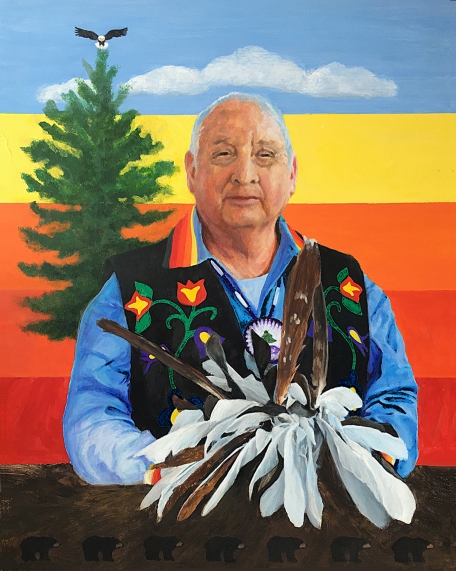
Throughout the Thanksgiving season, visual artist and educator Karen Kucharski, who graduated from Binghamton University in the ’80s, will have her piece “A Leader’s Love,” a portrait of Mohawk Leader Tom Porter, on display at the Waterman Conservation Education Center in Apalachin, New York.
Porter restored an Indigenous community along the Mohawk River that had been lost for generations. His portrait is one of six works Kucharski completed last year through a New York State Council on the Arts grant. Originally unveiled at the Waterman center, the series honors Haudenosaunee cultural leaders and supporters devoted to the peace-building philosophy of the “Two Row” wampum belt, an agreement first exchanged with the Dutch in 1613 promising “peace and friendship forever.”
“I have worked with Native people throughout my career in teaching and project roles because I want to do my part in bridging cultures,” Kucharski wrote in an email. “I am drawn to their beauty of spirit, of their arts, and cultural ways. Looking back, it seems natural that I would eventually want to paint their portraits.”
Her subjects include Indigenous and non-Indigenous individuals whose lives embody the values of the Two Row — Mohawk storyteller and educator Kay Olan, Onondaga paddler Hickory Edwards, Cayuga musician Dan Hill, Oneida rap artist Daygot Leeos and women’s rights activist Sally Roesch Wagner.
A University alumna, Kucharski recalled fond memories of playing intramural water polo, taking an African American dance class and how her time on campus impacted her career in the arts.
“I was an art student at BU during what some of my classmates and I call the ‘classic era’ of the Art department,” Kucharski wrote. “The quality of teaching was superb and was reflected in the support I felt as a student, dutifully carrying my portfolio from class to class, no matter in the Studio Art department or across campus.”
The NYSCA grant required strong local relevance and arrived at an important moment for Kucharski. Following New York State’s directive for public schools to retire mascots that depicted Indigenous peoples without authorization, Kucharski, as an alumna of a local district affected by the change, felt compelled to support it through her art.
“I understand the pride of having such a mascot, yet the foundation was weak because not enough of the history and cultural points of view were taught,” Kucharski wrote. “Especially in the high school years when it really matters. Also, the use of such mascots tends to push negative connotations.”
While the series contains six portraits, Kucharski looks to add to the project in the future. She still has other portraits she wants to complete to depict each subject’s “different story.”
The portraits on display are a result of personal encounters. After reaching out to Porter, he sent Kucharski a photo he had of her at a Haudenosaunee event from years before. The subjects of her portraits all contributed support to the pieces.
“They each devoted time for suggestions and sometimes images to develop the work,” Kucharski wrote. “Kay Olan, the storyteller, gave me an especially heartfelt message of thanks for helping to tell their story and show that they know who they are. As we stand together in such ways, we recognize each nation as sovereign and worth mutual respect.”
Reflecting on the collaboration, Kucharski noted how the experience deepened her appreciation for the stories depicted in each portrait and highlighted shared truths that bridge different cultures and backgrounds.
“The portrait reflects important aspects to him — seven generations of the Bear Clan, symbols of nature reflected in his clothing — which, too, reminds me of my own Polish and Slovak heritage I remember from childhood,” Kucharski wrote. “We all have ties to family, culture, and the earth deep in our existence. Let us rejoice in this shared humanity.”