





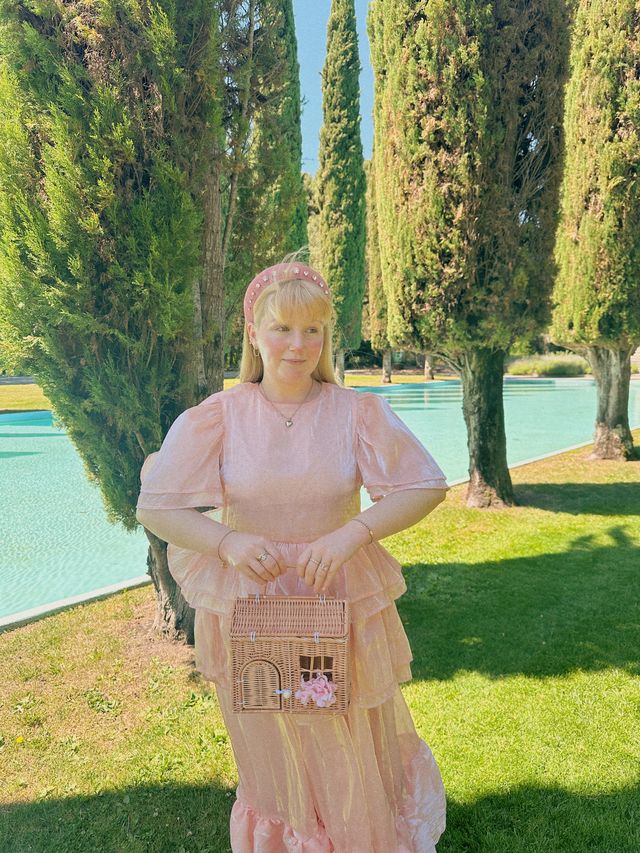
Anja Kotar, a pop artist and producer based in the Bay Area, released her single, “A Study In Waiting,” last month. With over 15,000 monthly listeners on Spotify and a master’s in music production from Berklee College of Music, Kotar produces her instrumentals utilizing live strings, acoustic guitar, harp, celesta and wind chimes. Part of Kotar’s project “At the Bookstore,” “A Study In Waiting” auralizes romantic literature through Disney-inspired orchestration and whimsical lyricism. The single grapples with the desire for a lasting love in a romanticized and cinematic auditory experience.
Your song embraces recognizable romantic and fairytale imagery through classical orchestration and a romance-novel framework. How do you make those familiar symbols feel personal rather than simply nostalgic?
“I think I use those references less as nostalgia and more as a language. Fairytales, romance novels and Disney stories give us this shared vocabulary for longing, anticipation and the idea of a love that feels larger than everyday life. What interests me is placing very real, very human emotions inside that heightened world. With ‘A Study In Waiting,’ the romance is deliberately idealized, but the feeling underneath it is much less tidy. It is about anticipation, uncertainty and the strange amount of imagination that can exist in the space before something actually happens. The classical elements work in a similar way for me. Interpolating Elgar’s ‘Salut d’amour’ gives the song this sweeping romantic language, but I wanted to use that language to tell a contemporary emotional story rather than simply reference the past.”
What themes did you intend on weaving throughout the work, and do you feel yourself frequently gravitating towards them in your artistry?
“I find myself returning a lot to romanticism, longing, imagination and the tension between ordinary life and the way we experience it internally. I am really interested in the idea that something objectively small can feel enormous when you are the person living through it. A lot of my music comes from wanting to romanticize those everyday experiences rather than waiting for life to become extraordinary on its own. There is something fascinating to me about how much emotion can accumulate in a moment where, technically, nothing has happened yet. I think that tendency to find drama, beauty and meaning in seemingly small moments is probably one of the most consistent threads throughout my work.”
Your music often has a very cinematic quality. What role does storytelling and imagery play in your songwriting and production process?
“Storytelling is a huge part of how I understand songs. I like a song to feel as though you have entered a little world for three or four minutes, and the production is just as important to building that world as the lyrics are. Imagery helps me make emotions tangible. Instead of only saying what somebody feels, I am much more interested in creating the room, the weather, the objects, the colors and the little details around that feeling.
That extends into production too. Arrangement, orchestration, instrumentation and dynamics can all tell parts of the story that never need to be stated explicitly in the lyric. I think that is where the cinematic quality comes from. I am not really separating songwriting from production in my head. They are both ways of deciding what the world of the song looks and feels like.”
What artists, genres or other forms of art have influenced the way you think about music and your creative identity?
“Classical music has obviously had a very strong influence on the way I think about melody, harmony and arrangement because of my background as a pianist. That influence has become increasingly visible in my own pop production too. My ‘12 Months’ project is probably the clearest example of that, since every song in the project interpolates a different piece of classical music. I love taking something that already carries so much history and musical identity and finding a way to place it inside a contemporary pop context where it can take on a completely new meaning.
Outside of classical music, I am very influenced by literature, musical theatre, film and fashion. I think I often approach songwriting almost like writing a very condensed piece of fiction, where you have a limited amount of time to establish a setting, a character and an emotional arc. Musical theatre has shaped that instinct too. There is something I love about the idea of essentially writing a musical version of your own life, where everyday experiences can become scenes and emotions can become songs. My current ‘At The Bookstore’ body of work leans especially heavily into literature and the relationship between songs and storytelling.
Fashion is another really important part of that process for me because I see it as a visual extension of the world of a song. The clothes, styling, artwork and imagery can communicate something about the character or atmosphere before somebody has even heard the music. I love when all of those different art forms can feed into one another and make the world around a song feel more complete.”
How do your personal experiences and the world around you influence the stories you tell through your music?
“A lot of my writing begins with very ordinary experiences, observations or emotions and then grows outward from there. I am interested in everyday life, but not necessarily in documenting it completely literally. I like taking something recognizable and heightening it through metaphor, imagery and production until it becomes its own little universe.
I think that is also why seemingly mundane details matter so much to me. The way somebody speaks, a place, a particular object or one fleeting interaction can sometimes communicate more than a very broad statement about an emotion. My songs tend to live somewhere between reality and imagination. The feeling at the center is grounded in something human and recognizable, but the world around it can become much more whimsical.”
You’re classically trained in piano. How did that early training shape the artist you’ve become today?
“It shaped almost everything about the way I understand music. Classical piano gave me a very structural relationship with harmony, melody, dynamics and form long before I started thinking about those things in the context of pop songwriting and production. It also taught me that interpretation matters. The notes themselves are only part of what makes a piece communicate something. Timing, articulation, phrasing and dynamics can completely change how the same material feels.
I think it has also affected how I produce. I tend to think about arrangements as interconnected parts rather than simply adding sounds until a track feels full. And increasingly, I have enjoyed allowing that classical background to become an audible part of the music itself through orchestration and classical references rather than keeping my identities as a pianist, songwriter and producer separate from one another.”
How has growing up in the Bay Area influenced your music, both creatively and culturally?
“Spending my formative years in the Bay Area has probably influenced my relationship with work as much as it has influenced the music itself. There is a huge work ethic culture here. You are surrounded by people who are building things, starting companies, studying, experimenting and treating ambition as something that has to be backed up by an enormous amount of consistent work.
That really affected the way I think about a creative career. There can be a romantic idea of songwriting or producing as something you only do when inspiration arrives, but I do not really approach it that way. Opportunities are made, and even something as creative as writing and producing music is ultimately rooted in routine, scheduling and showing up to work when you said you would. Obviously you cannot schedule the exact moment a great idea appears, but you can schedule the hours in which you give it the opportunity to appear. I think growing up around the Bay Area mentality made that feel very natural to me.”
Looking back at your earlier work compared to what you’re creating now, how do you think you’ve evolved as an artist?
“I think the biggest evolution has been becoming more specific. I have a much clearer understanding now of what I am drawn to and what I want a song to feel like beyond simply wanting to write a good pop song. The world around the music matters more and more to me. The writing, production, orchestration, imagery, artwork and larger concept all feel like parts of the same creative language.
I also think my classical background has become more integrated into the music I make. There is more room now for orchestral elements, literary references, unusual arrangements and the slightly whimsical side of my writing to coexist with pop without feeling like I have to choose between them. I still care enormously about melody and accessibility, but I feel much more comfortable building a very particular world around those things. The music feels more distinctly mine because I am less interested in separating the different parts of my creative identity from each other.”