





Willie Poon always wanted to be a psychologist. Sadly, though, he was never able to become one.
Poon died in a one-car accident on his way back to Binghamton after a trip to Ithaca nearly a year ago to the day. The driver of the car, who was the victim’s fraternity brother, was charged with vehicular manslaughter and driving while intoxicated.
This, along with other cases of alcohol-related deaths, was brought up Thursday at an alcohol education session, hosted by a conglomerate of fraternities called “The Machine.” According to Anthony Scaria, the social chair of Sigma Beta Rho, The Machine exists “to show that frats can coexist, no matter what their backgrounds may be.” The Machine was started in the spring of 2008.
“[Our goal] was to spread the idea that frats understand the consequences of binge drinking and that you should know your limits,” Scaria said.
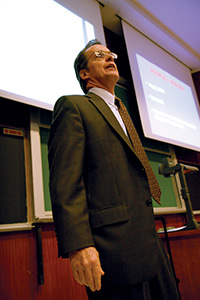
Guest speakers at the event included David Husch, director of Off Campus College; Larry King, a physical education instructor at Binghamton University and at a local Catholic school; and Mohammad Saqib, a member of the Phi Kappa Psi fraternity. Most attendees were members of fraternities and sororities.
Poon was a member of Lambda Phi Epsilon, a predominately Asian fraternity founded in 1981. Fraternity members described his personality: kind, friendly and always able to instill laughter in others. He sustained a skull fracture from the accident, causing his brain to swell, and though doctors at Cayuga Medical Center in Ithaca did everything they could, they were unable to save him.
Husch described the trauma inflicted on the families of those killed in drinking-related accidents. Once, a young man, after having been drinking with his friends, was dared to jump into a river and swim to the other side. He did so and disappeared — his body was not found until almost a month later. Panic gripped his family and friends while the young man was missing.
But, according to Husch, his case is not the only one of that kind.
“I hope no one ever has to experience the panic that gripped his family during the month he was missing,” Husch said.
King, the next speaker, used a physical metaphor to describe how over-consumption of alcohol can affect one’s life: juggling water bottles.
He handed two bottles to a volunteer from the audience, explaining that one represented school work and the other represented a social life — the two could be juggled with ease. King mentioned that many students do extracurricular activities such as community service, and added a third bottle to represent this, which made it significantly harder to juggle. Next, he added a fourth to represent excessive drinking, and the bottles went cascading to the floor as the volunteer could not juggle them.
This is exactly what will happen if one does not take precautions when drinking, King said.
Event organizers handed out a booklet, entitled “Shattered Lives,” that detailed several drunk driving tragedies from the perspectives of the victims and their families. The booklet was made by the Stop-DWI foundation of New York, and the introduction includes a quote by Broome County District Attorney Gerald F. Mollen: “In my view, one of the greatest failings in our criminal justice system is its almost single-minded focus on the effect of arrest and prosecution upon the accused, along with its remarkable disregard for the impact of the crime upon the victim and the victim’s friends and family.”
The session ended with a PowerPoint presentation that detailed the BAC (blood-alcohol content) legal standard for driving. It also defined the alcohol content of a standard drink.