





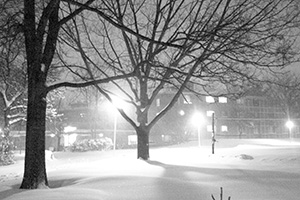
Many students were left without a ride to school Feb. 26, when Off Campus College Transport canceled its services because of the snow while classes remained in session.
Binghamton University classes were delayed that Friday until 9:40 a.m. and the blue buses were canceled through an SA-Line e-mail sent at 11:32 a.m.
Hazardous snow conditions the night before prompted Broome County Emergency Management to issue a state of emergency alert at 10:12 p.m., warning against unnecessary travel.
Giovanni Torres, service manager and operations coordinator of OCCT, was one of five OCCT committee members who decided to cancel bus services because of safety concerns.
“It was not a responsible decision on my part to allow buses to go in that sort of weather,” Torres said.
As bus drivers themselves, committee members take driving conditions into account each morning as they drive to school. They unanimously decide how buses should operate that day, then Student Association President Adam Amit makes the final decision whether or not to cancel OCCT service.
Torres called Amit Thursday night and expressed his concern about Friday’s driving conditions.
“I then proceeded to call Vice President for Student Affairs Brian Rose to discuss what he felt was the best decision going forward,” Amit said.
At that time Amit and Rose were in agreement to cancel services until 8 a.m. At 10 a.m. Torres and Rose decided it was unsafe to run the bus service.
“We recognized off-campus students could still make it to campus via Broome County Transit, but it really came down to safety,” he said. “We didn’t want to risk our passengers, drivers or buses, and that’s why we made the decision to cancel service.”
University officials, including James Van Voorst, vice president for administration, made the separate decision to continue classes based on the accessibility of campus roads.
“When there is a snow event, [the administration] works with the University police to keep watch on the roads,” Van Voorst explained. “If the police chief believes that the roads are impassable, then we … inform the president, who makes the final decision to cancel classes.”
According to Van Voorst, professors also had the option of canceling classes at their discretion.
In addition to concerns over road conditions, OCCT’s fleet of blue buses faced another impediment to providing its services — getting out of the garage.
“It would have been difficult to run buses because the [bus] garage was not plowed, and … our contingency roads were too hazardous,” Torres said.
He advised students to subscribe to OCCT’s Twitter, text messages and Web site services at occt.binghamton.edu to receive instant news developments.
“OCCT always tries to have bus services when there are classes,” Giovanni said. “This was one of the rare instances when we could not provide it — and we are sorry for that.”