





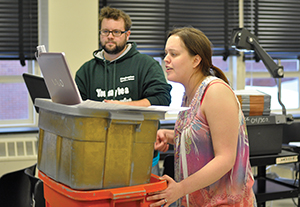
Debaters from universities across the Northeast gathered all day Saturday and Sunday to compete in Binghamton University’s Regional Debate Tournament.
From 5 a.m. to 10 p.m. Saturday and from 6 a.m. to 7:30 p.m. Sunday competitors competed in the Fine Arts Building, the Science Buildings and Lecture Hall for a chance to attend the annual National Debate Tournament, which will be held this year at the University of California, Berkeley.
One BU debate pair, Rob Glass, a senior majoring in history, and David Silverman, a sophomore majoring in English, were the top seed going into the novice division elimination round, with six wins and zero losses. They ended the day winning their bracket, which makes them Northeast champions in their division. Neither student had previous experience with debating in high school.
“Debates allow you to see something completely new,” Silverman said. “It is about anticipating opponents’ arguments before they say them or open their mouths.”
Though official results are not in yet, Glass said he has his “fingers crossed” for two pairs of BU debaters who are expected to pick up major wins from the weekend’s tournament. They would advance to the National Debate Tournament, which is widely regarded as the nation’s most prestigious tournament.
Alfred Schneider, University of Vermont professor and debate coach for over 30 years, explained how important debate is in developing the minds of the students involved.
“The purpose of this debate is twofold: first, to have a competition between colleges and universities, and secondly, to develop a package of critical skills that students need to succeed in the 21st century, of which include public speaking, message construction and critical thinking,” he said.
Tournament participants were able to compete in policy or world debate style of debates. Policy debate, which emphasizes research in competition, has two divisions, junior varsity and varsity. World debate is an alternative style that emphasizes less research and focuses more on the performance and speech during the debate.
According to Joseph Schatz, BU’s director of debate, less than a decade ago the University’s debate team was entirely student-run, with a $2,000 budget. Since that time, the team’s budget has increased to $30,000.
“It takes a certain select breed of people to be debaters,” Schatz said, adding that most of the members of BU’s debate team were on the Dean’s List for academic excellence.
He credited the success of the team to the dedicated alumni who return year after year, and who are always ready to help the team.
Awareness of current news topics is often cited as a necessity for debate. In addition to reading sources like The Economist, students often listen to BBC World News radio to stay up-to-date, according to Schneider.
Competitions often require a 20-hour time commitment, spread across Saturday and Sunday. Glass admitted that preparing for a debate can sometimes be “constant, constant soul-crushing work.” He said he had been preparing for the weekend’s tournament for eight to 10 hours per week since September of 2009.
Although Glass acknowledged that preparation for a debate is time-consuming, he emphasized how much he learned.
“Debating exposes you to a plethora of new ideas,” he said. “It helps improve your academics because many of the same skills are transferable.”