





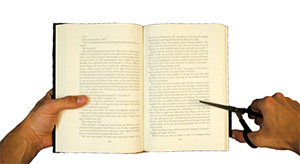
Binghamton University English majors may have more trouble fulfilling major requirements starting next semester because of tighter caps on some of their courses.
According to Harpur Associate Dean Jennifer Jensen, English majors are having problems getting into courses, including: ENG 227, 228, 245, 300M, 300P and 300W (See Page 5).
Many of these concerns and disputes are a result of the addition of a new introductory writing course, WRIT 111. WRIT 111 was created in fall 2008 for first-year students in place of the previous courses offered under the ENG 115 heading.
“The course is part of the writing initiative created in support with [Provost Mary Ann Swain],” Jensen said. “Because the faculty felt strongly that incoming students needed to improve [their] writing skills.”
The addition of the WRIT 111 course has used up some of the graduate teaching resources — the teaching assistants — which would normally have gone to other English courses.
“The reason for the caps is only partially due to budget cuts,” Gayle Whittier, a professor in the English department, said. “The second- and third-year English department Ph.D. students who might have supplied the graduate graders and discussion leaders have been told to expect that they will be assigned to WRIT 111.”
Another portion of the freeze on classes involves the TAs allocated to the various schools within BU.
“Financial constraints are real, but the underlying issue is prioritizing limited resources [TAs],” Whittier said. “[It questions] what the University values and how that impacts students’ access to both electives and requirements.”
According to Jensen, each department on campus is given a “TA line,” essentially a cap on the number of TAs that can be taken in within each department.
“The English department was given a certain allotted amount of TAs under the condition that a certain portion of those would go to the WRIT 111 course,” Jensen said.
Most universities, including BU, have English graduate students who would prefer to teach literature rather than composition. According to Jensen, in the case of WRIT 111, the graduate students would teach the composition courses because there is simply more of a need for them.
The freeze affects six required classes in the English department. According to Whittier, there were approximately 900 students originally affected by the capping of these courses. Sophomores were closed out of key courses during registration time; course sizes and TAs were then readjusted and registration reopened.
Shakespeare, ENG 245, is one of these required courses for English majors, as well as one of the courses currently frozen from students because of a lack of TAs. This caused a problem with the amount of seating available to students set to sign up for the class.
“It was decided that instead of messing with the scheduling for students, we put a freeze on the classes to fix them,” Jensen said. “After the seating numbers are corrected we will be opening them back up to students.”
According to Jensen, if students begin to have problems with finishing their requirements, there will be appropriate classes offered as a replacement for classes such as ENG 245. Whittier thinks that’s a mistake.
“There is no substitution for Shakespeare,” Whittier said, “Even courses that teach some Shakespeare do not offer the immersion of ENG 245 … That immersion is necessary because of the difficulty and the breadth of their influence in contemporary culture.”
According to Jensen, the process of reopening registration is already in place, and an e-mail has been sent out to sophomore English majors.
“We are still waiting to hear about the remaining courses that currently have holds on them, and we have no new information at this time,” the e-mail said.
The courses reopened were ENG 300M, 300P and 300W as of 9 a.m., April 23 for sophomore students.
However, Whittier is still fearful of these changes.
“I fear there will be a qualitative change in this year’s ENG 245 even if the numbers are lifted,” she said. “The students most eager to learn the subject may be diverted elsewhere by the time the cap is lifted.”
Jensen also said the provost’s office has been working to correct the situation since April 16.
“We are keeping the same system [of registration] to give sophomores the shot that they would have had if everything worked,” she said.