





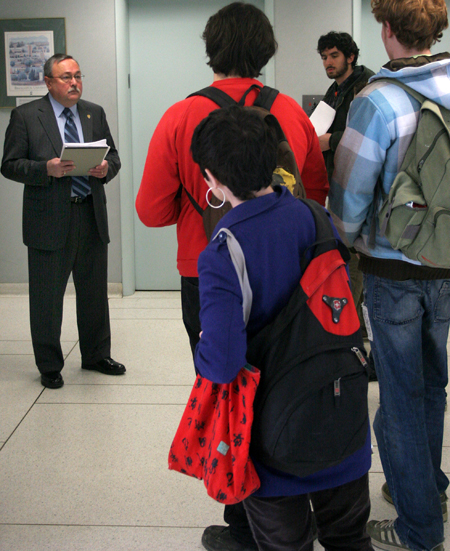
About 10 student activists opposing the use of Tasers by campus police were intercepted Friday by Binghamton University administrators in the lobby of the Couper Administration Building.
The students were delivering a stack of letters to the offices of President Lois DeFleur, Vice President for Administration James Van Voorst and Vice President for student affairs Brian Rose. The letters called on the University police department to “remove all Tasers from their arsenal.”
The activists included members of the Experimental Media Organization and BU’s chapter of Amnesty International.
The event was a result of a series of meetings this semester in which a core group of activists has been planning opposition to the deployment of Tasers to UPD.
EMO held a Town Hall forum on Feb. 25 to raise awareness about the Tasers.
“I went there, and that was the first I heard about the issue,” said freshman Meaghan Petix, one of Friday’s activists. “And as soon as I heard about it, I was completely against it. I brought it up at Amnesty — that’s when we got involved.”
Having been told in advance by EMO’s Andrew Epstein when the activists would deliver the petition, Lloyd Howe, dean of students, and Gail Glover, a spokeswoman for BU, stood in Couper’s lobby with several other staff members as the students entered the building. The officials declared their intention to receive the letters on behalf of intended recipients DeFleur, Van Voorst and Rose.
“What we’re doing here today is delivering over 150 individually signed letters calling for the administration to suspend the use of Tasers,” Epstein said. “We’re also submitting Amnesty International’s most recent report on the continuing concerns and excessive force related to Tasers.”
Howe said the officials were “unavailable” at the time and that the letters would be delivered to the respective individuals.
The tense but civil confrontation lasted only a few minutes before the students left the letters with Howe and Glover.
AN IVORY TOWER
Though they claimed they were “hopeful” that the petition would achieve their ends, several of the activists suggested shortly afterward that Couper Administration Building is an “ivory tower” for officials who make decisions without consulting the student population.
“I think it’s really pathetic that the administration is so distant from the student population that when we told them that we were coming they won’t talk to us,” Petix said.
Though he was not involved in the decision to arm campus police with Tasers, Howe defended it in an interview immediately after the confrontation. He said Tasers are a “non-lethal type of restraining device” that can be used in place of deadly force. He also said the decision was appropriate in light of recent campus violence throughout the country.
“We have to put it in perspective with what has been occurring on various campuses across the country, beginning with Virginia Tech and Northern Illinois University, although we had them before Northern Illinois University occurred,” Howe said.
He noted that a report issued in the wake of the Virginia Tech shooting recommended that all SUNY schools reassess their emergency preparations.
Stephanie Plude, one of the activists, quickly dismissed this argument and said the justification used by the administration is logically flawed.
“It’s not the kind of thing you can prevent with a Taser,” she said.
The University police department provided another explanation for the decision to arm officers with Tasers.
Assistant Chief of Police Bill Dunn described an incident of domestic violence that occurred as Binghamton residents took shelter in the BU’s Events Center during the 2006 floods, before the UPD was armed with Tasers.
A man ran from police into the fields on the North side of campus after being reported for a disturbance. According to Dunn, the man pulled a knife and threatened that if officers came near him he’d electrocute himself through an electric junction box near one of the playing fields.
Unable to respond with pepper spray because of its short range, the officers contacted the Binghamton police in an attempt to borrow a Taser, but none were available. Eventually, they were able to convince the man to surrender, but the incident left UPD unnerved.
After researching Tasers extensively, Dunn said he recommended to Police Chief John Schwartz that the department acquire them. Schwartz brought the issue to Van Voorst, who is the direct overseer of UPD, and the administration made the final decision to buy the Tasers.
USING THE FORCE
Tasers are weapons that deliver a powerful electric current through probes that can be shot as far as 35 feet. The current is strong enough to cause humans to lose control of muscular movement, stunning them. Though they inflict severe pain, in almost all cases a person who is shocked recovers almost instantly.
Much of the Taser controversy has to do with their classification in police use of force procedures. UPD classifies resistance along a continuum of five levels, from “compliant” to “assaultive.” According to Dunn, Taser use is allowed if resistance meets the criteria for the third level of force, called “resistant (active),” which translates to a person being non-compliant, but not necessarily fighting with an officer.
Many of the activists take issue with this classification. Andrew Epstein paraphrased a 2006 Amnesty International Report that states that classifying Tasers at a lower level of force than batons and hand guns make officers more likely to use them dangerously.
“They say that Tasers are a part of a routine force option, meaning that they’re not a substitute for deadly force, they’re a substitute for talking or manhandling or some of those other options,” Epstein said. “And the problem is that when you have something that’s deadly as part of your routine force options, you’re going to end up killing more people than you want.”
Dunn said that the use of Tasers at BU is controlled, reasonable and safe.
Every Taser is equipped with a camera that captures audio and video evidence of each use, which is preserved. Anyone who is shocked is entitled to seek medical attention afterward. Police are required to fill out paperwork to justify any use of force, including Tasers.
“I certainly couldn’t argue that it couldn’t be considered an instrument of torture, but certainly it would never be allowed to be used that way on this campus,” Dunn said. “We have such a tight control on what our officers do and how they do it.”
Glover said the campus police force has only three Tasers and that there has only been a single instance where a Taser was used — what she said was a “burglary situation in progress” in the fall 2007 semester.
A recent large-scale study conducted by Wake Forest University concluded that “The injury rate is low and most injuries appear to be minor. These results support the safety of the devices.” Reviewing almost 1,000 cases of Taser use recorded by six police departments, the researchers found only three cases that required the victim be hospitalized, including two deaths.
A 2006 Amnesty International report, which was delivered by the activists with the letters, contends that injuries and deaths caused by Tasers have been under reported by some studies. According to the report, Taser deaths are often officially recorded as death for another reason, such as drug overdose, despite the fact that the use of the Taser may have contributed to the death.