





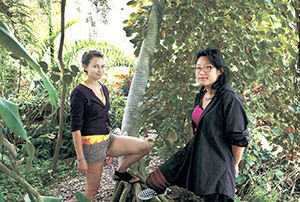
Allison Feldman and Hyo Kim have spent their past semester at Binghamton University in a classroom overrun by flies, mealybugs and thrips.
Under normal circumstances, the classroom might have been shut down and fumigated, but their classroom was BU’s E.W. Heier Teaching Greenhouse.
The two juniors were working on a program called Integrated Pest Management, in which they had the opportunity to research how to manage greenhouse pests without using chemical pesticides.
Kim, who is majoring in environmental chemistry, focused on the use of pheromones ‘ chemicals released by an organism into its environment ‘ on affected plants.
She said that she would swab affected plants with pheromones from the pests to bring them into a concentrated area; the next step was to ‘bring in beneficial insects, which will control the pest population by feeding on them.’ With the pests in a central location, their predators would have an easier time finding them.
The mealybug was one of the pests Kim encountered. To thwart the mealybug, she brought in Cryptolaemus, the ‘mealybug destroyer.’
Through experimentation, Kim soon discovered that the beneficial insects have been effective, yet costly.
‘These beneficial bugs are definitely helping in getting rid of these pests, but they are pretty expensive to ship and maintain. Some of them have short lifespans and others are hard to mate,’ Kim said.
Other means of chemical-free insect control included spraying plants with water, cutting old leaves and using soap to rid the greenhouse floor of algae and fungus.
Feldman, who is majoring in environmental science, researched how insects can act to protect some plants. On a trip to Costa Rica with her tropical biology class over spring break, she observed how some ant species protected their host trees.
‘When I visited Costa Rica, I was bitten by a swarm of ants after I placed my finger on the tree,’ she said. Feldman thought these ants were merely defending their habitat, but she discovered that they developed a strong relationship with the tree itself.
‘When damage is done to the cecropia plant, ants are recruited to the area to defend the tree,’ she said.
Although these specific species of ants and trees are not in the greenhouse, she wanted to incorporate the defensive nature of the ants toward their host plants to the greenhouse’s IPM system.
Laurie Kasperek, greenhouse manager in the biological sciences department, said this program was all part of a larger effort to rid BU of pesticides.
‘We’re hoping to eliminate the spraying of pesticides completely on this campus,’ she said. ‘If the University of Vermont was able to quit pesticide use for 10 years, I don’t see why Binghamton University cannot do it either.’
Although the greenhouse is used by classes in the art, biology, botany and geography departments, it is not frequented by students outside their studies.
‘Many kids walk by and around Science III, but are afraid of coming into the greenhouse,’ Kasperek said. ‘I would like to make it known that this greenhouse is open to the public. Students should stop by here since it’s open weekdays all year round.’
The E.W. Heier Teaching Greenhouse is located in Science III. The facility is open to the public Monday through Friday from 8:30 a.m. to 4:30 p.m.