





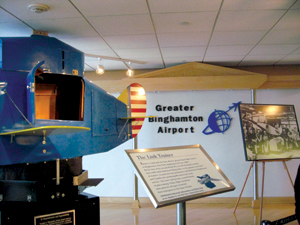
A Binghamton University computer science class is doing work that may benefit airports around the country.
Professional Ethics and Communication, taught by Professor William Ziegler, is collaborating with the Greater Binghamton Airport in the Federal Aviation Administration Design Competition.
This national competition challenges universities to create innovative ideas for airport operation.
One system being designed by Ziegler’s class uses geothermal heat to melt snow and ice on the airport’s aprons, where planes are parked and maintained.
They plan to pump water through underground rubber tubes, which would be conducted through Earth’s geothermal heat and warm the pavement on the aprons.
“Geothermal heating is done with homes, and we’re trying to find a way to apply that concept to an airport,” Giovanni Torres, a senior computer science major working on the project, said.
“Unlike shoveling snow in your driveway, you need to heat up a lot of space at an airport,” Torres added.
The other system is a safer method of disposing chemicals used to de-ice planes.
Up to 1,200 gallons of glycol, an odorless, colorless, syrupy, sweet-tasting toxic liquid, are used to de-ice a plane after landing. The runoff from these chemicals is trucked to a treatment facility and dumped into the Susquehanna River after being cleaned.
The class is hoping to eliminate time spent processing the chemicals.
“It’s always better if you didn’t have to clean and truck the glycol — that’s the idea,” Ziegler said.
The competition requires design teams to work with local airports on their projects.
“Carl Beardsley, the commissioner of the Greater Binghamton Airport, called me saying that they ‘were in’ after I left him a lengthy message explaining our ideas,” Ziegler said. “Right from the beginning they were really enthusiastic to work with us.”
Last week the class toured the airport and they will be able to visit for research upon request.
“We’re thankful to be working with the top-class students and faculty at Binghamton University,” Beardsley said.
The finished designs are due on April 16. These designs would have to be approved by McFarland Johnson, Inc., the engineers of the Greater Binghamton Airport, before becoming a reality.
Beardsley hopes these systems will reduce the airport’s operational costs if they are implemented.
“All northeast airports wrestle with maintenance finances during the winter months,” he said.
Zeigler is optimistic about the final outcome of the project, and he said that McFarland Johnson, Inc. could be able to bring their designs to other airports.
“We could become a leader of innovative ideas and put Binghamton on the map in terms of aviation design,” he said.
Students in Ziegler’s class are heavily involved with the projects, and Torres appreciates the challenge.
“Coming from a computer science background, you work a lot by yourself,” he said. “It’s good to gain experience working with a group.”