





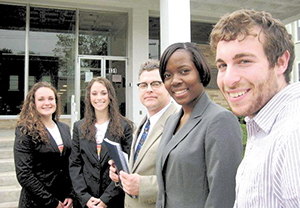
In an effort to help guide the American Civic Association into the future, a team of students in Binghamton University’s School of Management presented the ACA with $2,000 and a 148-page, 19-point strategic plan on May 17.
The team that worked with the ACA called themselves the ASANI Consultants, which stands for Aiding Solutions for Advancement for Non-Profit Organizations.
They were just one of eight teams in SOM’s Strategic and Organizational Strategy class, but not all teams had money to donate. The $2,000 donation from Manley’s Mighty Mart was awarded to ASANI because they placed first in the class-wide competition. Judging was conducted by a panel of consultants and high-level executives from across the country.
Nicole Grodin, an ASANI member majoring in marketing and consulting and leadership, said that ASANI interviewed four local non-profit organizations before deciding on the ACA, an immigration services organization that was the site of a shooting in April 2009 where 14 were left dead.
‘We felt that the ACA was the best fit for us,’ Grodin said. ‘They were in a period of rebirth after the tragedy and we felt as though they could greatly benefit from our assistance.’ The ASANI team also included Aaron Cohn, then a junior majoring in accounting and consulting and leadership; Lauren Scott, then a junior majoring in business management; Latoya Jn. Baptiste and Saidat Abiodun.
Kimberly Jaussi, an associate professor of organizational behavior and leadership in SOM, oversaw the class. She described the projects as a ‘win-win.’
Scott also felt that her experience benefited her as well as the ACA. ‘Working with the ACA was one of the most rewarding experiences that I have had at Binghamton thus far,’ Scott said. ‘The passion and dedication that exists within the organization is something to truly be admired and remembered.’
Jaussi also remarked on the projects’ breadth within the community. ‘We have alumni, community involvement, businesses, non-profit organizations and current students,’ she said. ‘I get to see involvement, alumni dedication and the way it changes students’ views about only wanting to make money, but instead helping the community.’
Like the other teams, ASANI worked closely with their partner organization. The students’ work included performing intensive research, data analysis and creating comprehensive strategic plans outlining specific recommendations, applying their knowledge from the class.
Every Friday, ASANI met with Andrew Baranoski, the executive director of the ACA. The team started with an internal analysis of the inner workings of the organization, according to Grodin.
‘We reviewed documents, financials, employee interviews and leadership styles. Then we did an external analysis of the community by surveying, researching immigration trends and other successful organizations in the community,’ Grodin said.
After data and information were acquired, ASANI started analyzing and inputting the information they found into several Leadership models to figure out areas of strength and areas that needed to be improved, Grodin said.
The final step in the process was creating a strategic plan which, according to Grodin, had taken more than 550 hours.
Their plan, she said, ‘was 148 pages and included 19 feasible recommendations for the ACA to implement, some of which we had already started to implement such as Facebook and sign-in sheets.’
Jaussi said that students continue to contact her after finishing programs.
‘I survey students and 99 percent say that they were overwhelmed at the start of the class,’ Jaussi said. ‘By the end of the class most of them are very amazed and impressed with the work they have accomplished.’