





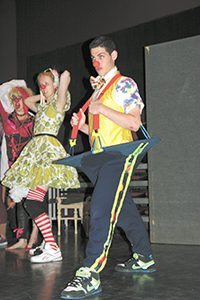
Deep within the brick walls of the Fine Arts Building lays a very well-kept secret. On Monday and Wednesday afternoons, the ground floor is filled with shrieks, music and an overwhelming wave of intense giggles and laughter. What is the source of this ruckus? Clowning class.
Twice a week the theater department offers a class taught by visiting theater professor Michael Toomey in which students can find their inner clown.
Toomey, who has been teaching clowning classes for about 10 years, has worked with kids as young as 8 years old to professional actors.
“The goal is for actors to go further with their own work, to reveal a new part of themselves,” Toomey said.
Ironically, this clowning class is no laughing matter. It’s intense, it’s draining and it’s an overall life-changing experience.
One student of the esteemed art of clowning, Jeremy Kimmelstiel, a sophomore majoring in biology, explains his own clown journey.
“In high school I loved theater, but when I signed up for this class I had no idea what I was getting myself into,” Kimmelstiel said. “It is easily my hardest class, and it is all that I think about.”
Clowning is not like any regular class — it takes preparation and it has the ability to change you as a person.
This transformation is something Toomey finds truly rewarding about teaching this class.
“One of my favorite things about clowning is getting to know that part of an actor that is most human and most vulnerable,” Toomey said.
There is a process to finding one’s inner clown. Over the past few months, individualized costumes have been created for each member of the clowning class.
Some costumes involve capes, shiny pink bats and sparkly bows. Others involve tutus with leopard-print tights. Each costume is designed by its wearer to accentuate the most humorous parts of their acting.
Kimmelstiel designed his costume to accentuate his hips once he realized that he swiveled them to evoke laughter from the crowd. Using an old pair of black sweatpants, he placed a hula hoop inside of the waistband, which is now an essential piece to his clowning costume. These pants are held up by bright red suspenders and are paired with a bold, yellow T-shirt.
As Kimmelstiel reflects back on the past few months of clowning, he recalls his first clowning exercise.
“The activity is called ‘Ring of Fire.’ The entire class stood in a circle and one person went in the center. The goal of the activity was for the person in the center to make every person laugh. I had 10 minutes to make the entire class laugh out loud at once. Let’s just say that I definitely stayed in the ‘Ring of Fire,’” Kimmelstiel said.
Kimmelstiel explains that he is always contemplating how his everyday actions influence his “inner clown.”
“Clowning has taught me to cope with everyday problems. This class has been an eye-opening experience as to who I really am. I have found myself nit-picking at my habits and realizing that it is OK to laugh at myself, and it’s OK for everyone else to laugh at me too,” Kimmelstiel explained.
Kimmelstiel also explained that clowning, to him, is similar to an out-of-body experience and has a very different approach to performing than other forms of theater.
“When we start class we have an hour of warm-up to loosen ourselves up. Before I get up in front of people to clown, I need to move myself to an energy level higher than what my body is accustomed to. I need to remove judgment and fear and let my mind go blank. While I am up there my body just goes. It’s only after [a performance] that I think to myself, I can’t believe you just did that,” Kimmelstiel said. “As an actor you are always told that when you are presented with a problem, you have to fix that problem. As a clown, you are not supposed to fix the problem, you are supposed to work with the problem.”
When one becomes a clown, there is no turning back — these crazy clowns are all bonded together through their passion for clowning. Come watch them perform at 1:10 p.m. May 3 in the Fine Arts Building. However, please laugh. Clowns are more sensitive than you may think.
“When people don’t laugh at my routine, it really ruins my day,” Kimmelstiel said.