


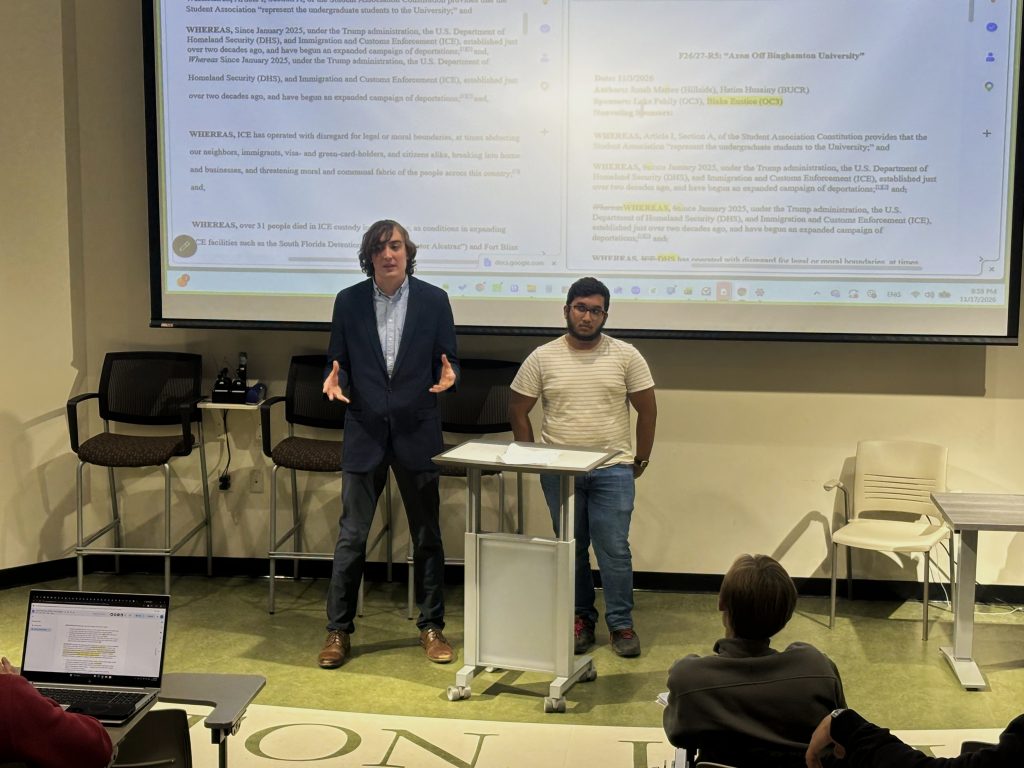
The Binghamton University Student Association passed a resolution to “strongly recommend” that the University end its contract with Axon Enterprise and implement an Immigration and Customs Enforcement safety plan.
The “Axon Off Binghamton University” resolution was authored by Hatim Husainy, a junior studying political science and sustainable communities and a BU Council Representative, and Jonah Matteo, a sophomore double-majoring in cinema and political science and a representative from the Hillside Apartments Community. The resolution was presented at the Nov. 17 Congress meeting, before BU’s contract with Axon goes into effect.
“I think that this is something that we need to work toward as a student body, and I think we have the momentum to do something about it now, but it needs to be done now,” Matteo said.
BU announced it would switch from Flock Safety to Axon Enterprise to supply automated license plate readers in October. ALPRs can be used by law enforcement to identify vehicles in ongoing investigations.
Flock Safety has been controversial among students over allegations that Flock supplied data to ICE. The Young Democratic Socialists of America organized against Flock with petitions, walkouts and town hall meetings. The University and Flock both denied the association with ICE. After the University’s announced switch to Axon Enterprise, the YDSA has continued to organize against ALPRs.
Axon Enterprise has also drawn controversy. President Donald Trump reportedly purchased between $1 and $5 million in Axon stock in March. Two weeks later, ICE bought 15,000 tasers from the company. Axon has also allegedly sold tasers to the Israel Defense Forces, which, according to an investigation, were used to torture prisoners.
The “Axon Off Binghamton University” resolution has two main aims. First, the resolution will encourage the University not to contract with Axon or any other private ALPR provider. Second, the resolution aims to implement a system to protect students from Immigration and Customs Enforcement, including using the B-Alert system to notify the student body if any immigration enforcement is suspected to be on campus and providing paid leave for staff handling immigration issues.
Rafi Josselson, a sophomore double-majoring in Judaic studies and history, claimed the resolution should not be passed because the SA Congress should not be a political body.
“We have a duty to remain, as a body, apolitical,” said Josselson. “With a whole student body, there are bound to be students who feel unrepresented and such a student who will hold beliefs contrary to the author and who think we should support ALPRs. True advocacy means ensuring that every voice is heard.”
The resolution links a petition by the YDSA to remove ALPRs on campus, which has around 3,000 signatures. Husainy said that this number of students is almost double the number that voted in the last SA election.
The resolution explicitly references the Trump administration and argues that the Department of Homeland Security is “abducting our neighbors” and “threatening [the] moral and communal fabric of the people across this country.”
Luke Fehily, a sophomore majoring in political science and an off-campus representative, argued the SA is a political body by nature and has been political since its founding.
The SA was founded in 1946 as “United Student Government.” By 1950, the SA was fighting for political issues, including protesting the Vietnam War and demanding social justice.
Fehily referenced Benjamin Franklin to begin his statement, saying, “If you’re willing to trade a little bit of freedom for a little bit of security, you deserve neither.”
“We should not stand back at a time when we can push forward,” Fehily later said. “We can correct things in such a critical way on this campus, and we can stand up and we can be on the right side of history. We can align ourselves with the Constitution and the founding principles of this nation.”
August Rey, a junior majoring in political science and the vice president of student success, said that running for a seat in SA Congress and then not wanting to discuss politics is “moronic.”
Following debate, the SA Congress voted on the resolution. With 11 votes in the affirmative, four against and five abstentions, the bill passed.
The YDSA will hold a rally against Axon on Nov. 20.
“Student Association Congress is the voice of the students as an institution, and on Friday we’ll get to see the voice of students as groups of people who come together to work together politically,” said Husainy in an interview with Pipe Dream after the meeting. “But I was honored to see that our leaders here are in agreement with the people on the ground.”